Why Understanding Dental Coverage Matters
Understanding how dental coverage works is the first step toward getting the most out of your plan and keeping your smile healthy. Most dental policies are organized around three core elements: a deductible you pay before insurance kicks in, an annual maximum that caps the insurer’s payment each calendar year, and a tiered benefit schedule that pays a higher percentage for preventive services than for basic or major procedures. Because the annual maximum resets on January 1 and does not roll over, any unused dollars are lost at year‑end, making it essential to schedule routine cleanings, exams and X‑rays before December 31. Preventive visits are usually covered at 100 % with no deductible, allowing you to catch early signs of plaque, gum disease or cavities and avoid costly restorative work later. By reviewing your policy, tracking benefit balance and staying on schedule for preventive care, you protect both oral health and your wallet.
Year‑End Strategies and Using Every Dollar of Your Benefits
Year‑End Benefit Maximization
| Action | Coverage Detail | Timing / Notes |
|---|---|---|
| Preventive visit (cleaning, exam, X‑ray, fluoride) | 100 % covered (often counts toward deductible) | Schedule in December to meet deductible early and use remaining benefits |
| Use FSA/HSA funds | Covers co‑pays, deductibles, cosmetic work not fully reimbursed | Spend balance before Dec 31 (tax‑free) |
| AI‑assisted imaging (Overjet) | Improves early decay detection, allowing treatment while benefits remain | Use at any visit; helps prioritize needed work before year‑end |
| MCNA (Louisiana) – preventive services | Fully covered cleanings, exams, X‑rays, sealants, fluoride every 6 mo | Plus modest coinsurance for restorations; crowns/bridges up to annual max |
| Medicaid (Louisiana) – adult dental | Limited: bi‑annual exams/cleanings, one X‑ray set, simple extractions, resin/amalgam fillings | $500 annual max; dentures only if ≤ 6 teeth; crowns/ortho generally excluded |
| Income eligibility for Medicaid (adult) | ≈ 138 % of FPL (≈ $18,000 for single adult, 2024) | CHIP for children up to 200 % FPL (≈ $31,000) |
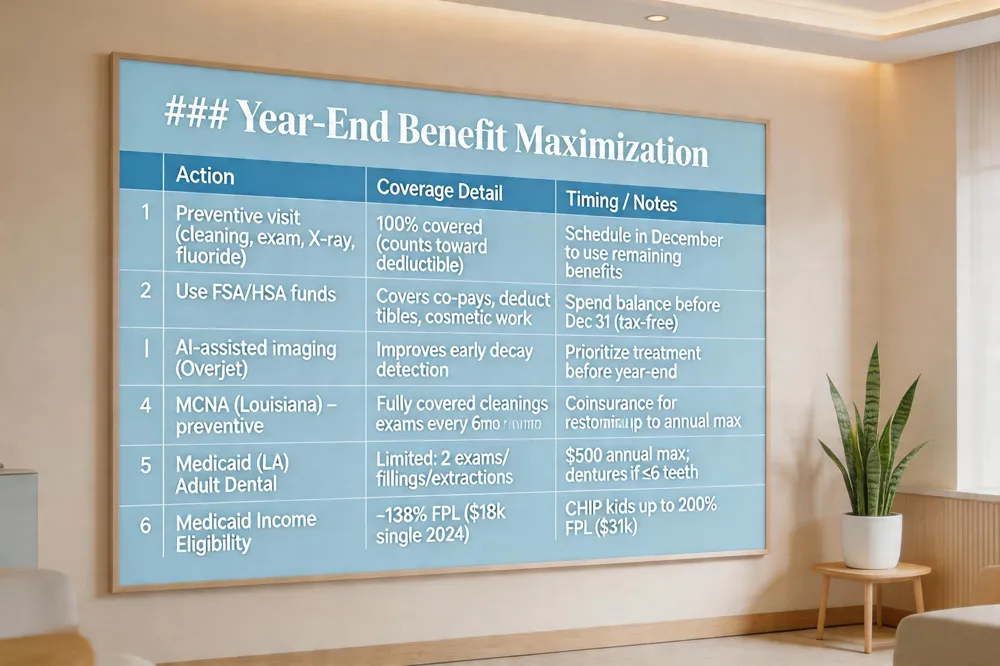 Dental benefits reset on January 1 and expire December 31, and Unused annual maximums are lost at year‑end. To make sure every dollar counts, start by scheduling a preventive visit in December—cleanings, exams, X‑rays and fluoride treatments are usually covered at 100% and help meet your deductible early. If you have a Flexible Spending Account (FSA) or Health Savings Account (HSA), spend the remaining balance before December 31; these funds can cover co‑pays, deductibles, or even cosmetic work that your plan doesn’t fully reimburse.
AI‑assisted imaging like Overjet enhances early decay detection, allowing you to treat problems while you still have benefit dollars left. ProHEALTH Dental recommends a final check‑up before Dec 31 to avoid losing benefits and to catch early signs of plaque, tartar, gingivitis, or cavities.
FAQ
- What does MCNA dental cover for adults in Louisiana? MCNA provides fully covered preventive cleanings, exams, X‑rays, sealants and fluoride every six months, plus restorative services (fillings, extractions, root canals) with modest coinsurance. Major work such as crowns, bridges and dentures is covered up to the annual maximum, with dentures replaceable every eight years.
- What does Medicaid cover for dental for adults in Louisiana? Medicaid offers limited adult coverage: bi‑annual exams and cleanings, one set of preventive X‑rays per year, simple extractions, and resin/amalgam fillings. A $500 annual maximum applies; dentures are covered only for members with six or fewer teeth, and crowns or orthodontics are generally excluded unless medically necessary.
- Free dental benefits Louisiana Low‑income adults, seniors and people with disabilities can receive free or reduced‑cost care through Medicaid, the Dental Services Program (administered by DentaQuest/MCNA), Federally Qualified Health Centers, the LSU Health Sciences Center School of Dentistry, and charitable programs such as Donated Dental Services.
- What is the maximum income to qualify for dental benefits? For adult Medicaid dental benefits in Louisiana, the income limit is about 138 % of the federal poverty level (≈ $18,000 for a single adult in 2024). Children’s CHIP eligibility is higher, up to 200 % of the poverty level (≈ $31,000). Private discount plans have no strict income caps but may use sliding‑scale fees.
Choosing the Right Plan: Coverage Types and Waiting Periods
Plan Comparison – Coverage Types & Waiting Periods
| Plan / Network | Preventive Coverage Start | Basic Coverage | Major Coverage | Annual Maximum | Deductible | Waiting Periods |
|---|---|---|---|---|---|---|
| Delta Dental PPO | Day 1 (preventive) | 80‑100 % after deductible | 50‑70 % (crowns, bridges) | $1,500‑$2,000 | Low or $0 | No waiting for preventive; minor waiting for basic/major |
| Humana Complete Dental | Day 1 (preventive) | 80‑100 % | 50‑70 % | $1,500‑$2,000 | Low | No waiting for preventive; basic may have 6‑mo wait |
| Cigna Dental PPO | Day 1 (preventive) | 80‑100 % | 50‑70 % | $1,500‑$3,000 | Low (≈ $19/mo) | No waiting for preventive; basic/major up to 6 mo |
| DHMO (e.g., local HMO) | Often day 1 | 80‑90 % | 60‑80 % | $1,500‑$2,500 | $0 | Some waive waiting for major work |
| Individual Plans (outside employer) | Varies; check "no waiting for preventive" | Varies | Varies | $1,500‑$3,000 | Choose deductible | Look for explicit "no waiting" language |
| MCNA Dental (Louisiana Medicaid) | Limited adult coverage; preventive 2×/yr | Modest coinsurance | Up to annual max for crowns/bridges | $1,500‑$2,000 (state‑mandated) | $0 | No waiting for covered preventive services |
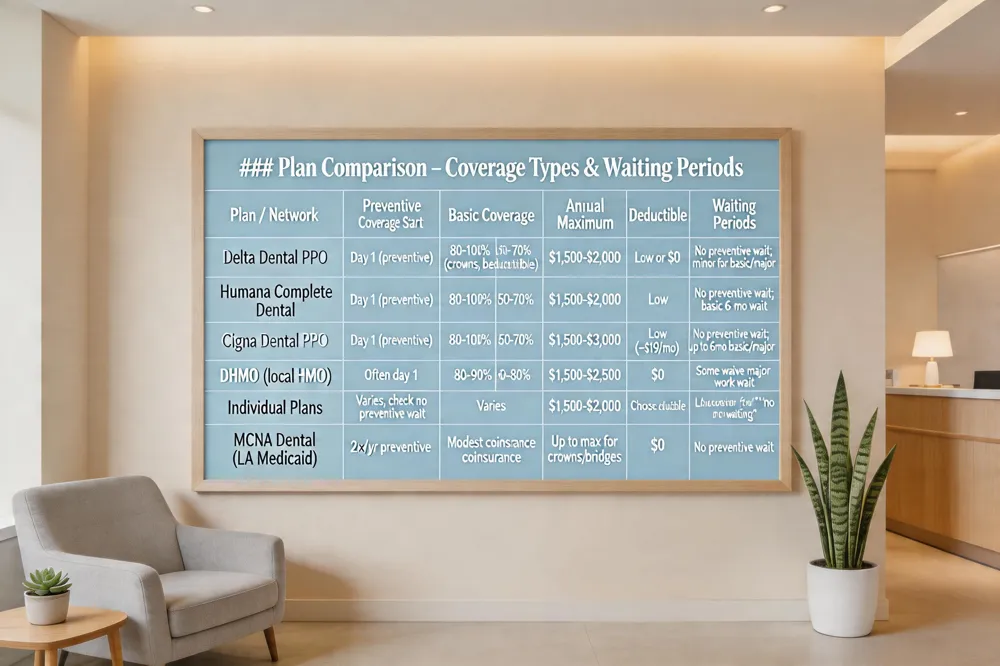 Full‑coverage dental insurance plans such as Delta Dental, Uniana Dental, and Cigna Dental provide a broad range of services—from preventive cleanings to crowns, bridges, root canals, and sometimes orthodontics or implants—typically with an annual maximum of $1,500‑$2,000 and low or no deductible. Many plans start covering preventive care on day one, so you can schedule a cleaning, exam, fluoride treatment, and X‑rays right after enrollment. This immediate coverage is common in Humana’s Complete Dental plan and Delta Dental PPOs, while some DHMO options even waive waiting periods for major work. Individual dental insurance, purchased outside of employer groups, lets you choose coverage level, deductible, and maximum that fit your budget; Cigna’s low‑deductible plans start around $19 per month, offering up to $1,500‑$3,000 in benefits. For families who want no waiting period at all, look for plans that explicitly state “no waiting for preventive services” and confirm in‑network status with your dentist. In Louisiana, the most widely‑recommended options are the large PPO networks—Delta Dental, Humana, and Cigna—because they have extensive Shreveport provider rosters and reasonable annual maximums. For Medicaid recipients, MCNA Dental is often favored over DentaQuest due to its URAC/NCQA accreditation and added perks like a $10 Amazon gift card, while both deliver the state‑mandated EPSDT benefits for children and limited adult services.
Specialty Procedures and Coverage Limits
Specialty Procedure Coverage Limits
| Procedure | Category | Typical Coverage % (in‑network) | Separate Annual Max (if any) | Notes |
|---|---|---|---|---|
| Dental Implants | Major | 20‑30 % coinsurance (80‑70 % patient) | $500‑$1,000 for implant‑related fees | Often requires separate max; use FSA/HSA for balance |
| Wisdom Tooth Extraction | Major (oral‑surgery) | 50‑80 % | Usually part of overall $ max | Verify oral‑surgery benefit & any waiting period |
| Crowns, Bridges, Dentures | Major Restorative | 50‑70 % (some plans 80 %) | $2,000‑$3,000 (higher‑max plans) | Choose high‑max plan; schedule before Dec 31 |
| Orthodontics | Separate Lifetime Max | Varies (often 25‑50 % of cost) | Lifetime max (e.g., $5,000) | Not usually covered for adults unless medically necessary |
| Medicare (Original) | None (routine) | 0 % | N/A | Only Medicare Advantage may include limited emergency dental |
| Medicare Advantage (selected) | Emergency only | Varies (often 50‑80 %) | Small annual cap | Check plan details for coverage scope |
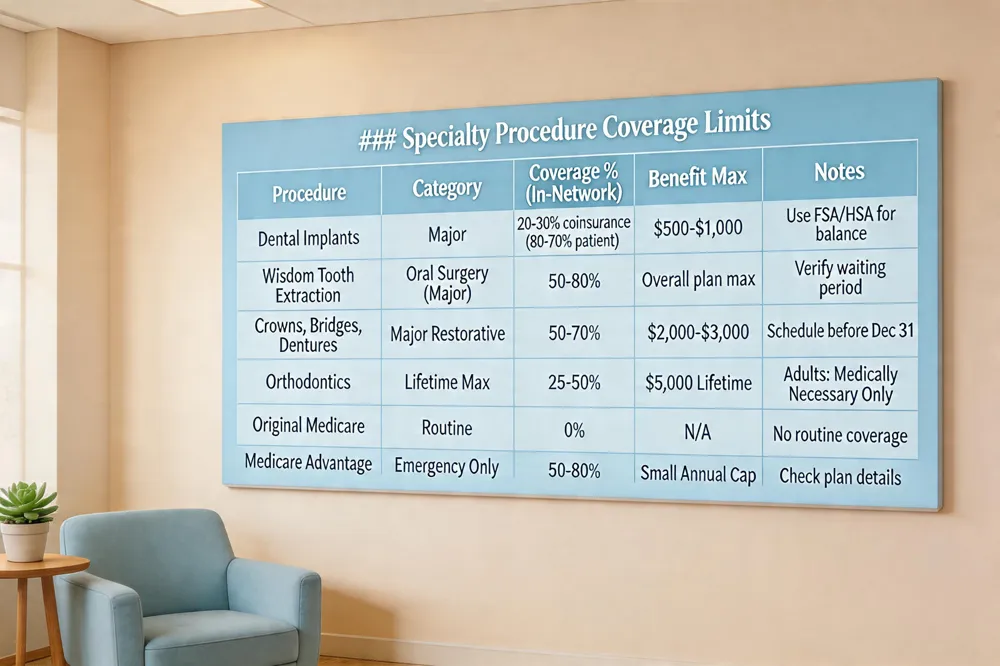 Dental insurance plans usually separate benefits into preventive, basic and major categories, and each category has its own coverage rules and annual caps.
Implant coverage – Only a few plans list implants as a covered major service, often with a 20‑30 % coinsurance and a separate annual maximum of $500‑$1,000 for implant‑related fees. Choose an in‑network provider (e.g., Delta Dental or Cigna Dental) to lower out‑of‑pocket costs and consider a Health Savings or Flexible Spending Account for the remaining balance.
Wisdom tooth extraction – Most plans treat oral‑surgery as a major service, covering 50‑80 % of the cost. Verify that the plan includes oral‑surgery benefits and any waiting period before you need the extraction. Insurance can turn a $500‑$2,000 expense into a manageable copay.
Major restorative work – Crowns, bridges and dentures fall under major restorative care. Look for a plan with a high annual maximum ($2,000‑$3,000) and low coinsurance. Delta Dental Dental Premier or Cigna Dental PPO are strong options.
Medicare and dental emergencies – Original Medicare does not cover routine dental care or a dental abscess. Medicare Advantage plans may include limited emergency dental benefits, but you must check each plan’s details.
Maximum annual benefit limits – Most plans cap payments at $1,000‑$2,000 per year; unused amounts are lost on Dec 31. Orthodontic benefits often have a separate lifetime maximum. Using preventive services early and scheduling major work before year‑end helps you capture the full benefit.
Health Conditions, Family Value, and Practical Tips
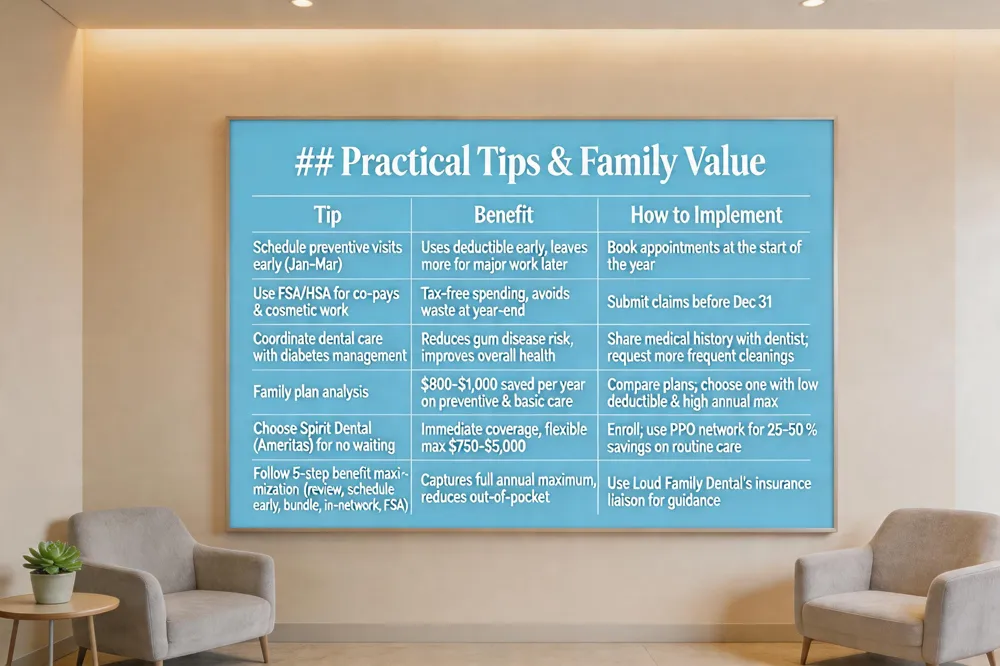
Practical Tips & Family Value
| Tip | Benefit | How to Implement |
|---|---|---|
| Schedule preventive visits early (Jan‑Mar) | Uses deductible early, leaves more for major work later | Book appointments at the start of the year |
| Use FSA/HSA for co‑pays & cosmetic work | Tax‑free spending, avoids waste at year‑end | Submit claims before Dec 31 |
| Coordinate dental care with diabetes management | Reduces gum disease risk, improves overall health | Share medical history with dentist; request more frequent cleanings |
| Family of analysis | $800‑$1,000 saved per year on preventive & basic care | Compare plans; choose one with low deductible & high annual max |
| Choose Spirit Dental (Ameritas) for no waiting | Immediate coverage, flexible max $750‑$5,000 | Enroll; use PPO network for 25‑50 % savings on routine care |
| Follow 5‑step benefit maximization (review, schedule early, bundle, in‑network, FSA) | Captures full annual maximum, reduces out‑of‑pocket | Use Loud Family Dental’s insurance liaison for guidance |
 Diabetes and oral health – People with diabetes are at higher risk for gum disease, cavities and other infections. Regular dental visits are essential, and good blood‑sugar control helps keep those risks low. At Loud Family Dental we coordinate with insurers, Medicaid, or community clinics to provide cleanings, fluoride treatments and early‑intervention care that fit your health needs. Schedule an appointment today to protect your smile while supporting your overall diabetes management.
Is dental insurance worth it for a family? Yes. For a typical family of four, annual premiums are often offset by $800‑$1,000 saved on preventive cleanings and basic restorations. Coverage encourages twice‑yearly check‑ups, catching problems early and preventing costly crowns, root canals or emergency visits. Insurers such as Delta Dental offer online tools to find in‑network providers and estimate costs, making it easy to maximize benefits at Loud Family Dental.
Spirit Dental insurance – Underwritten by Ameritas Life, Spirit Dental offers individual, couple and family plans with no waiting periods. Premiums start around $16.09 per month and annual maximums range from $750 to $5,000. Using an Ameritas PPO network dentist saves 25‑50 % on routine cleanings, exams, orthodontics, implants and major restorations. Benefits begin the day after enrollment, and plans include a $100 lifetime deductible and a 12‑month rate guarantee.
Step‑by‑step benefit maximization – 1) Review your plan’s coverage and annual maximum. 2) Schedule preventive visits early in the year. 3) Bundle basic procedures to use remaining benefits efficiently. 4) Choose in‑network providers like Loud Family Dental. 5) Use a Flexible Spending Account (FSA) for extra tax‑free savings.
Putting It All Together at Loud Family Dental
Loud Family Dental – Integrated Services
| Service | Feature | Patient Benefit |
|---|---|---|
| AI‑assisted imaging (Overjet) | Advanced decay detection, tartar & gum disease mapping | Early treatment, maximizes remaining benefits |
| Flexible scheduling (evenings/weekends) | Extended office hours | Fit appointments into busy lives, avoid missing year‑end window |
| Insurance liaison team | Coverage verification, claim submission, FSA/HSA guidance | Seamless paperwork, ensures full use of benefits |
| Year‑end benefit planning reminders | Alerts for remaining annual maximum, scheduling crowns/aligners before Dec 31 | Prevents loss of dollars, optimizes coverage |
| In‑network provider network (Delta Dental, Cigna, UnitedHealthcare) | Wide PPO participation in Shreveport | Lower out‑of‑pocket costs, higher reimbursement rates |
| Comprehensive preventive care (cleanings, exams, fluoride) | 100 % coverage for preventive services | Meets deductible early, keeps oral health optimal |
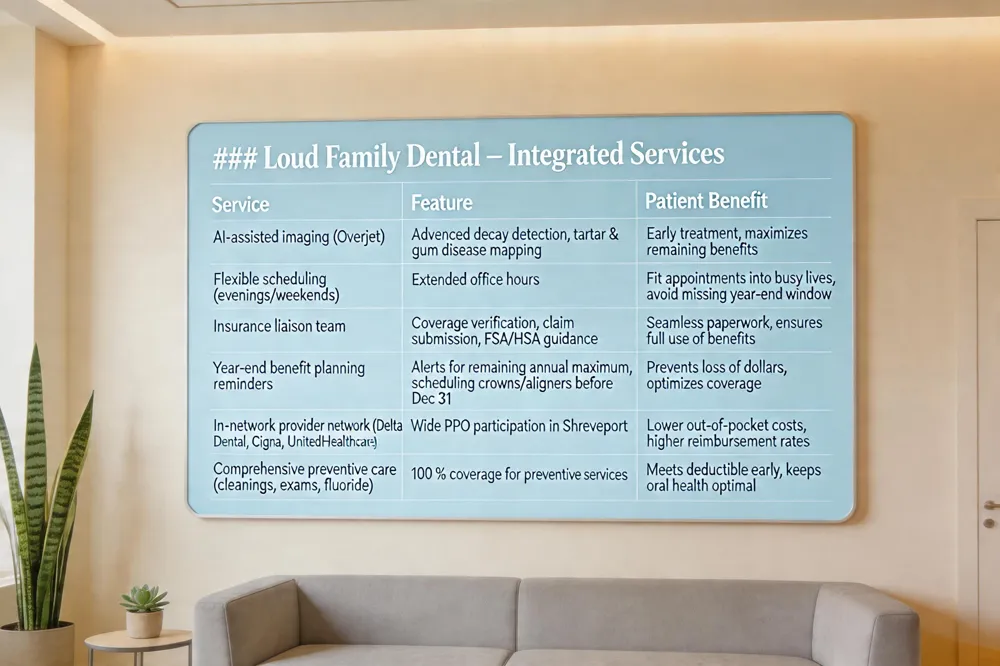 At Loud Family Dental we blend a patient‑focused environment with cutting‑edge technology and personalized service to make every visit comfortable and productive. Our friendly staff greets you in a calm, soothing setting and takes the time to explain procedures, easing any anxiety you may feel. To catch problems early, we employ AI‑assisted imaging tools—such as Overjet’s advanced diagnostic software—that quickly identify decay, tartar, and gum disease, giving the dentist a precise roadmap for treatment.
Understanding that life gets busy, we offer flexible scheduling, including evening and weekend hours, so you can fit preventive cleanings, exams, or larger restorative work into your calendar without hassle. Our dedicated insurance liaison team works behind the scenes to verify coverage, submit claims, and help you navigate FSAs, HSAs, and the nuances of your Delta Dental, Cigna, or UnitedHealthcare plan. They also guide you through year‑end benefit planning, reminding you to use remaining annual maximums before December 31, scheduling crowns, aligners, or sleep appliances to maximize your coverage and minimize out‑of‑pocket costs. Together, these elements create a seamless, supportive experience that keeps your smile healthy all year long.
Take Control of Your Oral Health Today
Start by reviewing your dental insurance policy—note the annual maximum, deductible, and which services are covered at 100% (usually cleanings, exams, and X‑rays). Use the online insurance‑check tool on the Loud Family Dental website to confirm network status for carriers such as Delta Dental, Cigna, UnitedHealthcare, and Aetna, and to see any remaining benefit dollars before December 31. Schedule a year‑end appointment promptly; a routine check‑up in December lets you use any leftover preventive benefits, catch early signs of plaque or cavities, and plan larger restorative or orthodontic work that can be split across two benefit years. Loud Family Dental’s staff will verify eligibility, submit claims, and provide cost estimates so you can maximize coverage, reduce out‑of‑pocket costs, and finish the year with a healthier smile.