Quick Start
When a dental emergency strikes, call Loud Family Dental right away at (636) 629‑1103. The front‑desk staff will quickly triage your call, asking about the pain’s intensity, when it began, any bleeding, swelling, or trauma, and your medical history and current medications. Based on this information they reserve a same‑day or next‑day emergency slot—often within a few hours—to stop bleeding, relieve pain, and prevent infection from spreading. Prompt treatment not only eases discomfort but also reduces the risk of complications like abscesses or tooth loss. Arriving prepared with a symptom log and medication list helps the team act swiftly and get you back to normal activities as fast as possible.
The 24‑Hour Walk‑In Option
24‑Hour Walk‑In Summary
| Service | Details |
|---|---|
| Availability | Walk‑in at any time; after‑hours line for directions and triage |
| Triage | Quick questionnaire on arrival to assess pain, bleeding, swelling |
| Imaging | Digital X‑rays or other imaging to detect hidden fractures, infections, displaced teeth |
| Immediate Treatments | Topical anesthetics, local anesthesia, temporary dressings, bonding, root‑canal therapy, extractions, emergency crowns |
| Outcome | Bleeding controlled, pain relieved, tooth saved in a single visit |
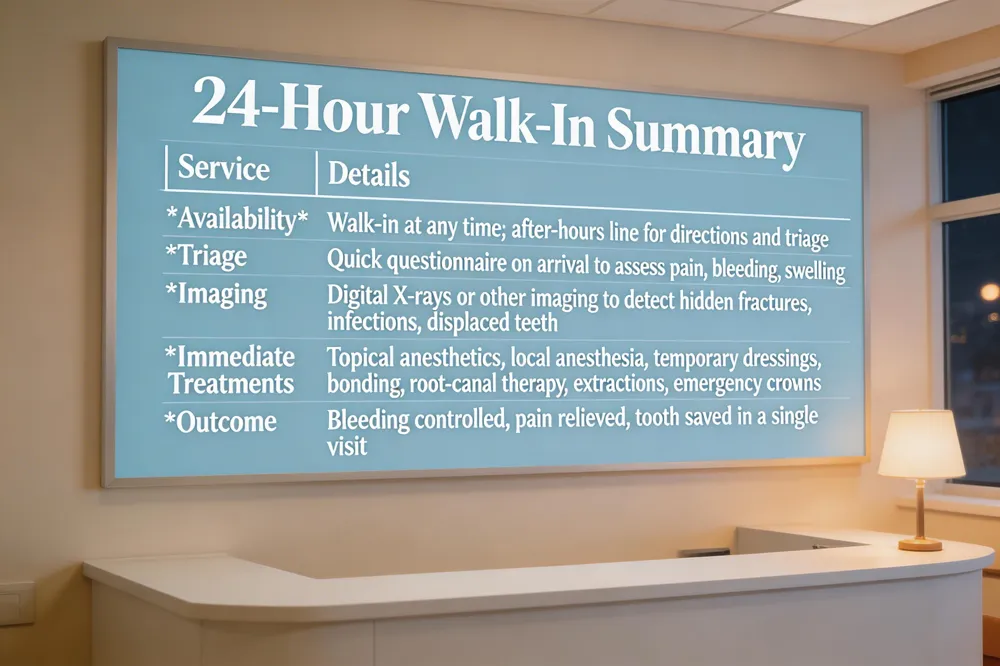 Loud Family Dental in Shreveport offers a true 24‑hour walk‑in option for dental emergencies, so you don’t have to wait for an appointment when urgent pain strikes. Whether you’re battling a severe toothache, a knocked‑out tooth, a broken crown, or sudden facial swelling, the clinic’s after‑hours team is ready to see you promptly. Upon arrival, a quick triage questionnaire determines the severity of the problem, and the dentist performs a focused examination along with digital X‑rays or other imaging to diagnose hidden fractures, infections, or displaced teeth. Immediate treatment tools in the office include topical anesthetics, local anesthesia, temporary dressings, bonding, root‑canal therapy, extractions and emergency crowns, allowing most urgent issues to be stabilized in a single visit. Patients can simply walk into the office at any time, or call the after‑hours line for directions and brief triage instructions. This 24‑hour walk‑in service ensures that bleeding is controlled, pain is relieved, and the chance of saving a tooth is maximized, keeping your smile healthy day or night.
Step‑by‑Step Inside the Emergency Appointment
Emergency Appointment Flow
| Step | Description |
|---|---|
| 1. Call & Triage | Front‑desk gathers pain intensity, duration, bleeding, medical history; schedules same‑day slot |
| 2. Arrival & Exam | Focused visual exam of affected area |
| 3. Imaging (if needed) | Digital X‑ray to reveal hidden issues |
| 4. Pain Relief | Topical numbing gel, local anesthesia, or mild oral sedation |
| 5. Immediate Procedures | • Bonding/filling chipped/broken tooth<br>• Temporary crown/restoration<br>• Begin root‑canal therapy<br>• Drain abscess & prescribe antibiotics<br>• Re‑implant knocked‑out tooth (30‑60 min) |
| 6. Post‑Treatment Guidance | Home‑care instructions, medication dosing, schedule follow‑up in 1‑2 weeks |
| 7. Duration | 45 min – 2 hrs depending on case complexity |
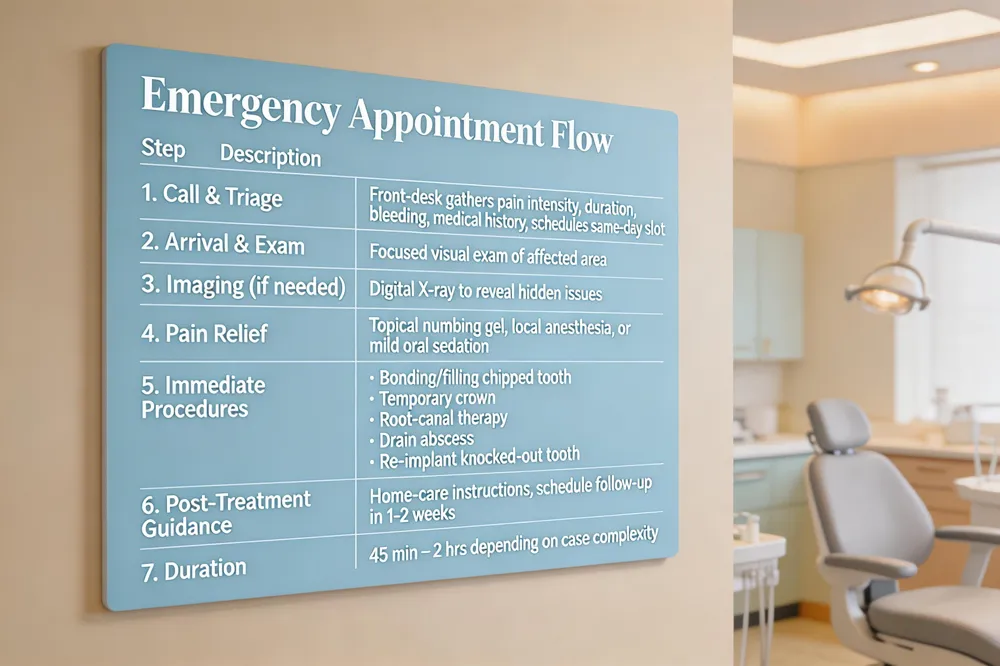 When you call a dental office with a sudden toothache, knocked‑out tooth, or swelling, the front‑desk staff performs a quick triage and symptom questionnaire. Within minutes they ask about the pain’s intensity, duration, any bleeding, and your medical history, then slot you into the next available emergency slot—often the same day.
Upon arrival the dentist conducts a focused visual examination of the affected area, followed by digital X‑ray imaging if needed. These rapid radiographs reveal hidden fractures, infections, or bone loss that aren’t visible to the naked eye.
Pain‑relief is the next priority. The clinician may apply a topical numbing gel, inject local anesthesia, or offer mild oral sedation for anxious patients. This ensures you are comfortable before any definitive work begins.
Common immediate procedures include:
- Bonding or filling a chipped or broken tooth
- Placing a temporary crown or restoration
- Initiating root‑canal therapy for a severe infection
- Draining an abscess and prescribing antibiotics
- Re‑implanting a knocked‑out tooth within 30‑60 minutes if possible
After the treatment, the dentist provides clear home‑care instructions—dietary restrictions, ice‑pack use, warm salt‑water rinses, and medication dosing—and schedules a follow‑up visit within 1‑2 weeks to monitor healing and plan any definitive restorative work. The entire appointment, designed to deliver rapid pain relief, infection control, and tooth stabilization, typically lasts between 45 minutes and 2 hours, depending on the complexity of the case.
When to Head to the Emergency Room
ER vs. Dental Office – When to Choose the ER
| Sign / Situation | Recommended Action |
|---|---|
| Severe facial/jaw fracture | Go to ER immediately |
| Deep laceration that won’t stop bleeding | ER (call 911 if needed) |
| Uncontrolled bleeding (>10‑15 min pressure) | ER / 911 |
| Swelling compromising airway (tongue, throat, neck) | ER / 911 |
| Systemic infection (high fever + rapid facial swelling) | ER for urgent evaluation |
| Other dental emergencies (knocked‑out tooth, cracked crown, localized abscess) | Contact emergency dentist (same‑day care) |
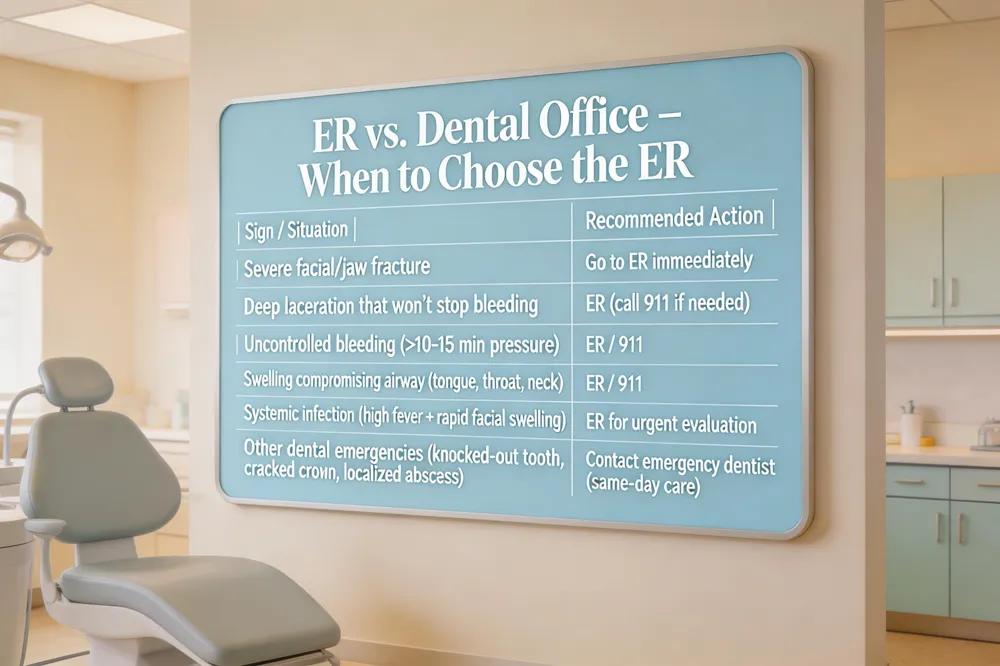 Dental problems that threaten life or overall health require immediate hospital care, not just a visit to an emergency dentist.
Life‑threatening dental trauma signs – Severe injuries such as facial or jaw fractures, deep lacerations that cannot be stopped with pressure, or a tooth that has been completely avulsed with bone involvement are medical emergencies.
Uncontrolled bleeding and airway‑compromising swelling – If bleeding persists after 10–15 minutes of firm gauze pressure, or if swelling rapidly expands to the tongue, throat, or neck making it hard to swallow or breathe, call 911 or go to the nearest emergency department.
Systemic infection indicators – A high fever combined with fast‑growing facial swelling, especially around the jaw or under the chin, suggests an infection may be spreading to the bloodstream or sinuses. This situation also demands prompt ER evaluation.
Guidelines for seeking hospital care vs. dental office care – For most dental emergencies—knocked‑out teeth, cracked crowns, severe toothaches, or localized abscesses—contact an emergency dentist who can provide targeted treatment within the same day. However, when any of the above life‑threatening signs appear, prioritize the emergency room to protect your airway, stop bleeding, and address systemic infection risks.
When should you go to the ER for dental emergencies? You should go to the emergency room when a dental problem involves life‑threatening trauma or a systemic health risk. This includes facial or jaw fractures, deep lacerations that cannot be stopped with pressure, severe swelling that blocks the airway or makes swallowing difficult, and uncontrolled bleeding that won’t pause after 10–15 minutes of firm pressure. A high fever accompanied by rapid swelling of the face, neck, or throat—signs that an infection is spreading—also warrants an ER visit. If you experience intense pain with any of these signs, seek hospital care immediately rather than waiting for a regular dentist. In all other cases, such as a knocked‑out tooth, cracked crown, or moderate toothache, an emergency dentist can provide appropriate treatment.
Dental Care Rules: 3‑3‑3 and 7+4
Key Oral‑Health Rules
| Rule | What to Do |
|---|---|
| 3‑3‑3 | • Brush 3×/day (breakfast, lunch, bedtime) <br>• 3 minutes each session <br>• Replace toothbrush/brush head every 3 months |
| 7+4 (children) | • First primary tooth appears at ≈7 months <br>• By 11 months (7 + 4) 4 teeth should be visible |
| Why it matters | Reduces plaque, cavities, gum disease; monitors normal eruption; lowers emergency visits |
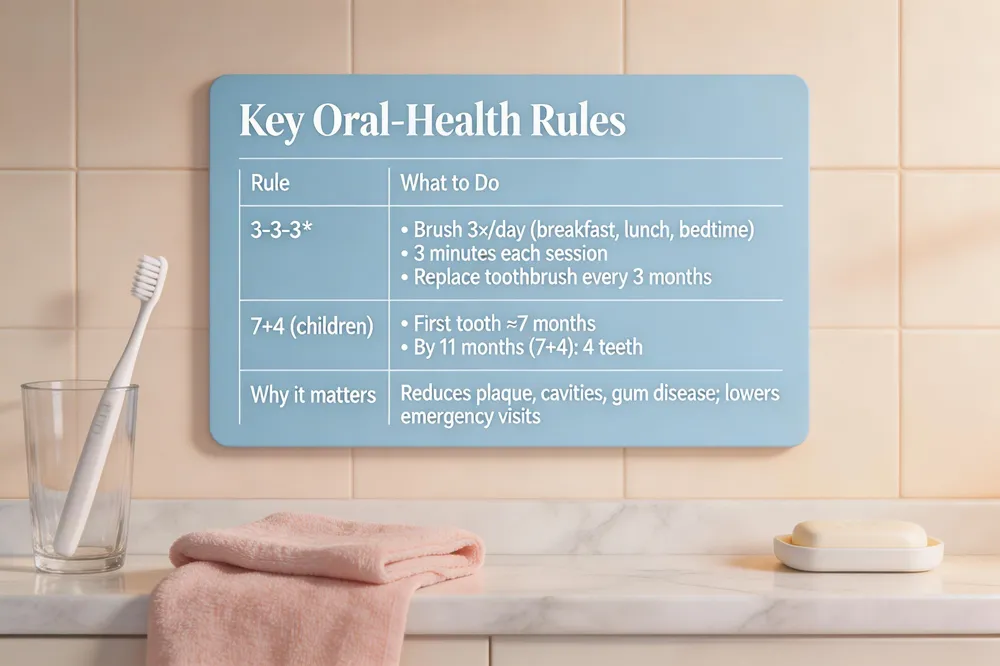 Keeping a mouth healthy starts with simple, repeatable habits. The 3‑3‑3 rule is a quick‑to‑remember brushing guideline: brush three times a day, spend three minutes each session, and replace your toothbrush (or brush head) every three months. Brushing after breakfast, lunch, and before bed interrupts bacterial growth, while a three‑minute routine lets you clean all four quadrants without rushing. Soft‑bristled brushes at a 45° angle and gentle pressure protect gums, and fresh bristles maintain plaque‑removal efficiency.
Toothbrush replacement schedule is built into the rule—every three months, or sooner if bristles become frayed. Worn bristles lose their cleaning power and can harbor bacteria.
For children, the 7+4 mnemonic helps parents track primary tooth eruption: at about 7 months the first tooth appears, and by 11 months (seven + four) four teeth should be visible. Knowing this timeline aids early detection of delayed eruption or developmental issues.
Why do these rules matter? Consistent brushing and timely brush changes reduce plaque, cavities, and gum disease, while monitoring eruption supports proper oral development. Together, they lay a strong foundation for long‑term oral health and fewer emergency visits.
After the Emergency: Follow‑Up and Prevention
Post‑Emergency Follow‑Up & Preventive Care
| Follow‑up Action | Timeline / Details |
|---|---|
| Schedule return visit | Within 1‑2 weeks for temporary crowns, root‑canal completion, extraction healing |
| Medication compliance | Take antibiotics as prescribed; OTC pain relievers as needed |
| Dietary instructions | Soft foods for first 24‑48 hrs; avoid hard foods (ice, popcorn kernels) |
| Swelling control | Ice packs 15 min on/15 min off; warm‑salt‑water rinses after meals |
| Long‑term prevention | Cleanings every 6 months, custom mouthguard for sports/night, avoid hard foods |
| Patient education | Ongoing guidance on oral hygiene, eruption monitoring, and emergency signs |
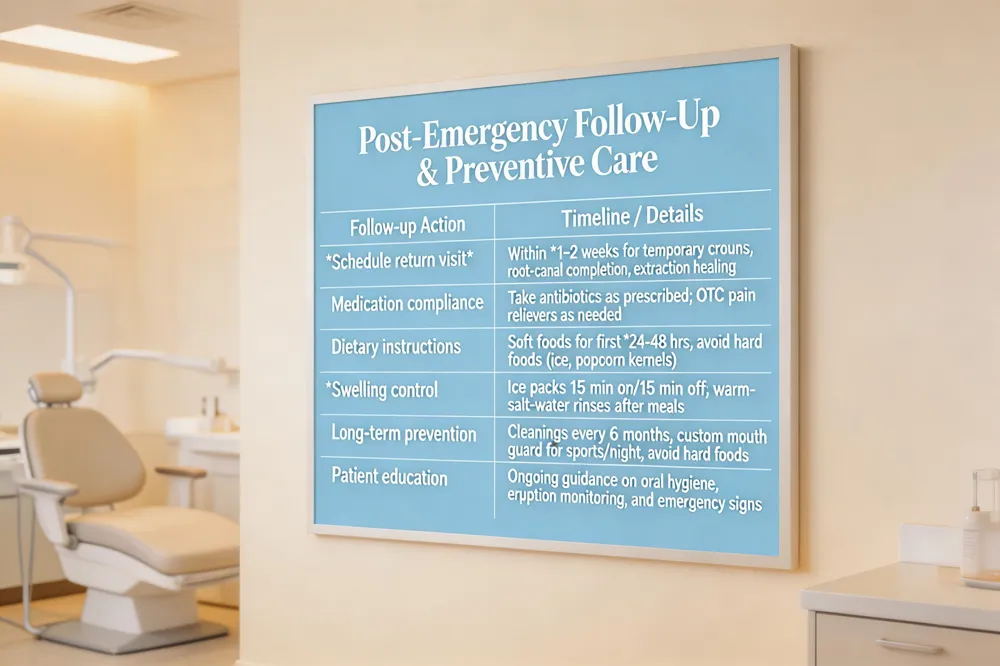 Once the urgent issue is stabilized, the next step is a well‑planned follow‑up. At Loud Family Dental in Shreveport, we schedule a return visit within one to two weeks for patients who received temporary crowns, root‑canal therapy, or extractions. This appointment allows us to place a permanent restoration, complete the root canal, or check the healing socket and ensure the tooth is ready for a final crown or bridge.
Post‑procedure care is simple but essential: take any prescribed antibiotics exactly as directed to clear infection, use over‑the‑counter pain relievers for comfort, and stick to a soft‑food diet for the first 24‑48 hours. Ice packs applied to the cheek for 15‑minute intervals help reduce swelling, and a gentle warm‑salt‑water rinse after meals keeps the area clean without irritating the surgical site.
Long‑term prevention is the cornerstone of our philosophy. Regular cleanings every six months, wearing a custom‑fitted mouthguard during sports or at night, and avoiding hard foods such as ice or popcorn kernels protect teeth from future trauma. Our community‑oriented approach means we educate every patient on these habits, schedule routine check‑ups, and remain a trusted resource for any unexpected dental concerns.
Staying Ready for Dental Emergencies
When a dental crisis strikes, the fastest path to relief begins with a quick phone call. Loud Family Dental’s front‑desk staff triages the issue within minutes, asks about pain, swelling or trauma, and schedules a same‑day or next‑day slot—often within 30‑60 minutes for life‑threatening problems like a knocked‑out tooth. Upon arrival, the dentist conducts a focused exam, takes digital X‑rays if needed, manages pain with local anesthesia, and either stabilizes the tooth with a temporary restoration or performs definitive treatment such as a root canal, bonding, or extraction. For any urgent need, call (757) 498‑6420. Maintaining good oral hygiene, wearing a mouthguard during sports, and avoiding hard foods can prevent many emergencies, while keeping the clinic’s emergency line saved ensures you’re ready when the unexpected happens. Loud Family Dental is committed to providing a calm, community‑focused environment where comfort and professional care are the top priorities.