A Brief Overview of Orthodontics
Orthodontics is the dental specialty dedicated to diagnosing, preventing and correcting mis‑aligned teeth and jaws, improving bite function, aesthetics and oral health. Its roots stretch back over three millennia: ancient Egyptians and Etruscans used gold bands or cat‑gut cords to hold teeth in place, while Greek physicians such as Hippocrates noted crowding in the 5th century BC. In the 18th century Pierre Fauchard introduced the “bandeau,” a horseshoe‑shaped expansion device, and the 19th‑century saw Christopher Delabarre’s wire crib and Edward Angle’s malocclusion classification that formalized orthodontics as a science. By the 1970s adhesive‑bonded brackets and stainless‑steel wires replaced cumbersome bands, and today digital 3‑D imaging, CAD/CAM and clear‑aligner technology enable precise, patient‑centered treatment. These advances also allow rapid 3‑D printing of custom appliances and AI‑driven treatment planning, further shortening appointments and enhancing outcomes for patients of all ages.
From Ancient Roots to Modern Science
 Orthodontics is a dental specialty that focuses on diagnosing, preventing, and correcting misaligned teeth and jaws. It involves the evaluation of bite problems, known as malocclusions, and the use of appliances such as braces, clear aligners, and retainers to move teeth into proper position. By aligning the teeth and improving the relationship between the upper and lower jaws, orthodontic treatment enhances chewing function, speech, oral hygiene, and overall dental health, while also delivering cosmetic benefits.
Early attempts at tooth alignment date back to ancient Egypt, Greece, Rome, and the Etruscans, where metal bands, catgut cords, and gold wires were wrapped around teeth to guide eruption. Greek philosophers Hippocrates and Aristotle (400‑300 BC) documented crowding and malocclusion, marking the first recorded orthodontic observations. In the 18th century, French dentist Pierre Fauchard introduced the "bandeau," a horseshoe‑shaped iron device for palate expansion, laying groundwork for modern appliances. The 19th century saw the rise of systematic orthodontic practice, with figures like Delebarre’s wire cribs and Edward Angle’s malocclusion classification, which together established the scientific foundation of contemporary orthodontics.
The Birth of Modern Braces
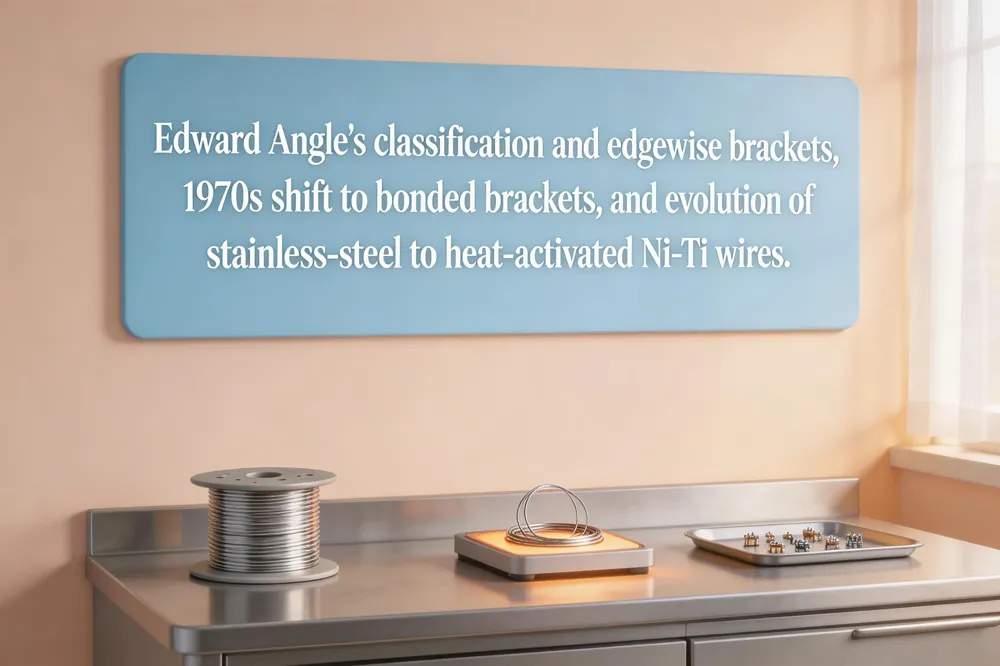 In the late 19th century, Dr. Edward H. Angle laid the foundation for today’s orthodontics by creating the Angle Classification system and founding the Angle School of Orthodontia in 1899. His work standardized how malocclusions are diagnosed and treated, and it introduced the first edgewise brackets that would later evolve into the brackets we use today.
During the 1970s, orthodontic appliances underwent a major transformation: the bulky full‑band designs were replaced by adhesive‑bonded brackets that stick directly to each tooth. This shift not only made braces more comfortable but also allowed for more precise control of tooth movement.
Around the same time, stainless‑steel archwires became the standard material, offering durability and consistent force. Later, heat‑activated, NASA‑designed alloys were added, giving wires the ability to become more flexible at mouth temperature and apply gentler, continuous pressure.
Because metal braces can exert greater, adjustable forces, they remain the treatment of choice for complex malocclusions—such as severe crowding, deep overbites, or large skeletal discrepancies—where precise three‑dimensional control is essential.
Why don’t dentists recommend Invisalign for complex cases?
Invisalign relies on patient compliance (wearing trays 20‑22 hours daily) and applies intermittent pressure, which may not generate enough force for severe rotations, large gaps, or major bite issues. Consequently, for deep overbites, extreme underbites, or extensive skeletal discrepancies, metal braces provide more predictable and reliable outcomes.
Materials and Mechanics: Metal to Ceramic
 Modern orthodontics offers a menu of appliances that move, guide, and stabilize teeth. The work‑horse today is the Metal braces consist of brackets bonded to each tooth and a connecting wire. In the 1980s Ceramic braces provide a more aesthetic option with tooth‑colored brackets, delivering the same mechanics as metal but blending with natural dentition for a more discreet look. Self‑ligating brackets use a sliding mechanism instead of elastic ties, reducing friction, shortening adjustment intervals, and improving comfort. For patients who want the braces hidden, lingual braces placed behind teeth make them invisible from the front, delivering identical forces while remaining invisible from the front. Wire technology has also advanced: Nickel‑titanium (Ni‑Ti) alloys provide shape‑memory and constant low‑force movement; heat‑activated Ni‑Ti wires, originally designed by NASA, become more flexible at body temperature, allowing smoother, faster tooth translation. Together, these materials and designs give clinicians a flexible toolbox to treat everything from mild crowding to complex bite discrepancies.
The Clear Revolution: Aligners
 Invisalign entered the market in the late 1990s after Stanford graduate Zia Chishti created the first clear‑plastic tray, kick‑starting the modern aligner era. Today, digital 3‑D scanning, CAD/CAM design, and rapid 3‑D printing turn a virtual model of your teeth into a series of custom‑fit trays in just a few days, eliminating messy impression trays and allowing precise treatment simulations.
The trays are made from BPA‑free, medical‑grade polymers (SmartTrack) that provide consistent, gentle forces, while small tooth‑colored SmartForce attachments give the system extra grip for complex movements.
Cost varies: a typical comprehensive case runs $5,000–$7,000 in the United States, with many dental insurance plans covering 50‑80 % and reducing out‑of‑pocket costs to $2,500–$4,000. Simpler packages can be as low as $1,500, while extensive cases may exceed $8,000.
Adult patients enjoy a range of options—traditional metal braces, discreet ceramic or lingual brackets, and removable clear aligners. Aligners are especially popular for their near‑invisibility, ease of oral hygiene, and ability to eat without restrictions.
Is $5,000 a typical cost for Invisalign? Yes, it falls within the common price range for most moderate to comprehensive treatments.
What are the price differences between metal braces and clear aligners? Metal braces usually $3,000–$7,000; clear aligners $3,000–$8,000, with insurance covering similar portions of each.
What orthodontic treatment options are available for adults? Options include metal braces, tooth‑colored ceramic braces, behind‑the‑teeth lingual braces, and removable clear‑aligner systems such as Invisalign, often enhanced with accelerated techniques for faster results.
Digital Dentistry and AI: The Latest Trends
 Orthodontics in 2025 is driven by rapid digital advances and artificial intelligence. Intra‑oral scanners capture a precise 3‑D model of the mouth, which CAD/CAM software turns into custom brackets, wires, retainers and clear aligners that are printed or milled on‑site. AI analyzes those scans, predicts tooth movement, and generates optimal force vectors, allowing clinicians to fine‑tune treatment plans in real‑time.
Tele‑orthodontics and remote‑monitoring apps let patients upload photos or scans, so orthodontists can check progress and make adjustments without a full office visit, cutting the number of appointments. Accelerated techniques such as micro‑vibration devices or hormone‑stimulating accessories stimulate bone remodeling, often halving treatment time.
Self‑ligating brackets reduce friction and the need for frequent adjustments, while lingual systems place brackets behind the teeth for a truly invisible look. Together, these technologies make modern orthodontic care faster, more comfortable, and far more discreet than ever before.
Patient Experience: Treatment Time, Disadvantages, and Retention
 Orthodontic treatment length varies by appliance. Traditional metal braces generally require 18‑24 months, while ceramic or self‑ligating brackets may be slightly shorter. Clear aligners such as Invisalign often finish in 12‑18 months for mild‑to‑moderate cases, but complex movements can extend to 24‑30 months.
Typical duration for different appliances – Metal braces: 18‑24 months; Ceramic brackets: 18‑24 months; Clear aligners: 12‑18 months (simple) to 24‑30 months (complex).
Common side effects and challenges – Adjustments cause soreness, brackets can trap food, and aligners demand 20‑22 hours of daily wear. Some patients experience enamel decalcification, root resorption, or gum irritation if oral hygiene lapses.
Importance of retainers and risk of relapse – After active treatment, a retainer must be worn (often full‑time for several months, then nightly) to prevent the teeth from shifting back; relapse rates exceed 50 % without proper retention.
Financial and lifestyle considerations – Costs range from $3,000‑$7,000 for braces and $4,000‑$8,000 for aligners; braces are usually covered by insurance, while aligners may be pricier due to digital scanning. Braces restrict certain foods and require meticulous cleaning, whereas aligners are removable, allowing a normal diet and easier hygiene.
Answers to key questions
- How long does orthodontic treatment typically take? Orthodontic treatment usually lasts between 12 and 30 months, depending on case severity, appliance type, and patient compliance.
- What are the disadvantages of orthodontic treatment? Disadvantages include cost, the need for regular visits, discomfort after adjustments, dietary restrictions (especially with metal braces), potential side effects like enamel decalcification or root resorption, and a high risk of relapse if retainers are not worn.
Your Smile, Our Commitment
At Loud Family Dental in Shreveport, our orthodontic team blends decades‑long expertise with the latest digital technologies to create comfortable, personalized smiles. Using 3‑D intra‑oral scanners and advanced imaging software, we generate a virtual model of each patient’s dentition, allowing us to simulate tooth movement and craft a treatment plan that fits both the clinical needs and the lifestyle preferences of every individual. Our community‑focused practice prioritizes patient comfort—whether you choose clear aligners, ceramic brackets, or traditional metal braces, we ensure minimal irritation and easy oral hygiene. We’re proud to offer flexible financing and a welcoming environment for families, teens, and adults alike. Ready to start your journey to a healthier, more confident smile? Schedule a consultation today and let us design the perfect orthodontic solution for you.