Why Verify Insurance Before Scheduling?
Checking a patient’s dental coverage before the appointment is a simple step that protects both the patient and the practice. Accurate pre‑appointment verification tells the patient exactly what portion of a procedure will be covered, any co‑pay or deductible that must be met, and whether a waiting period or pre‑authorization applies. This financial transparency lets patients plan for out‑of‑pocket costs and avoid surprise bills. For the dental office, confirming eligibility early reduces claim denials, streamlines the revenue cycle, and speeds cash flow by ensuring that claims are submitted correctly the first time. In short, verification creates a smoother, more trustworthy experience for everyone involved.
Understanding Dental Insurance Timing and Waiting Periods
Service Timing & Waiting Periods
| Service Type | Coverage Starts | Typical Waiting Period |
|---|---|---|
| Preventive (cleanings, exams, X‑rays) | Day 1 | None |
| Basic Restorative (fillings, simple extractions) | After enrollment | 3–6 months |
| Major (crowns, bridges, dentures, implants, oral surgery) | After enrollment | 3 months – 12 months |
| Some PPOs (e.g., Humana Complete, Cigna Dental 1500) | After continuous coverage | May waive major‑service wait after 12 months of prior coverage |
Key takeaway: Preventive care is always immediate; major procedures require the longest wait unless a plan explicitly waives it.*
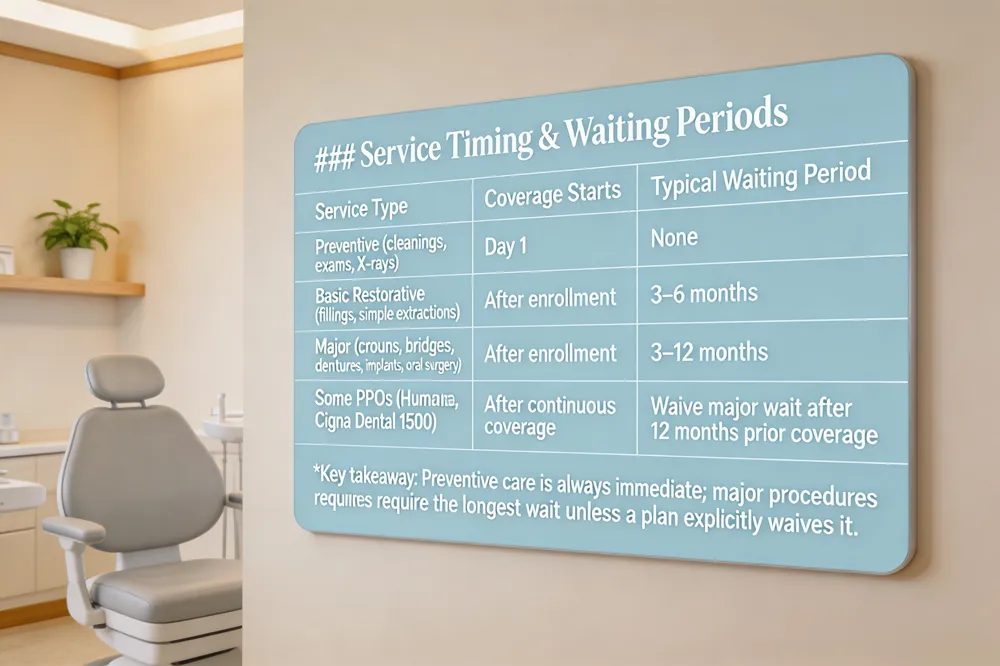 Getting coverage right before a procedure can feel urgent, but most dental plans impose waiting periods that dictate when specific services become payable. Preventive care—cleanings, exams, X‑rays— is usually covered from day one, so you can schedule those visits immediately. Basic restorative work such as fillings often has a short three‑to‑six‑month wait, while major services like crowns, bridges, dentures, implants, or oral surgery may require three months to a full year before the insurer pays its share.
Do any dental insurance plans offer no waiting period for major services? A few high‑premium PPOs and employer‑sponsored plans waive the typical 6‑ to 12‑month wait if you have continuous prior coverage. For example, Humana’s Complete Dental plan removes the 12‑month wait after 12 months of continuous coverage, and Cigna Dental 1500 provides “no waiting periods for select services” under similar conditions.
What does a 12‑month waiting period mean? It means that major procedures won’t be reimbursed until you’ve been enrolled for a full year. Until then, you’ll be responsible for the entire out‑of‑pocket cost, while preventive and some basic services remain covered. Once the year passes, the plan will apply its usual percentage to those major treatments.
How Dental Offices Verify Eligibility and Benefits
Verification Workflow Checklist
| Step | Description | Typical Time |
|---|---|---|
| 1. Collect Demographics | Full name, DOB, address, insurance card details | 1–2 min |
| 2. Run Eligibility Check | Use payer portal or call 48–72 hrs before appointment | 5–30 min (manual) / <2 min (automated) |
| 3. Review Benefits | Verify effective dates, annual max, remaining benefits, percentages, deductibles, waiting periods, frequency limits | 2–5 min |
| 4. Document Results | Screenshot/print, note date, time, staff name, upload to chart | 1–2 min |
| 5. Communicate Estimate | Share cost estimate with patient before treatment | 2–5 min |
Average total per patient: ~15 minutes when manual; under 5 minutes with real‑time software.*
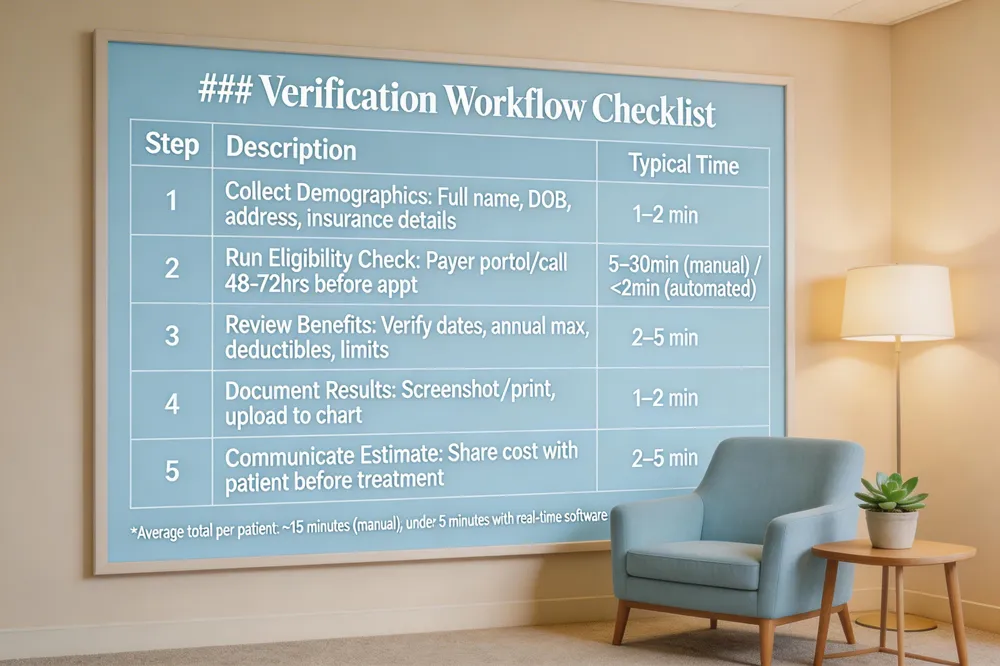 Dental offices follow a clear workflow to confirm a patient’s insurance before treatment. Workflow and timing – staff collect the patient’s full name, DOB, address and and every card details, then run a verification at least 48–72 hours before the appointment; a real‑time check is done at check‑in if needed. Typical checklist items include core demographics, primary and secondary carrier names, member and group numbers, effective dates, annual maximums, remaining benefits, coverage percentages for preventive, basic and major services, deductible status, waiting periods, frequency limits, and any pre‑authorization or referral requirements. Time required – manual phone or portal checks usually take 5–30 minutes per patient, averaging about 15 minutes, while automated eligibility software can return results in under two minutes, often in seconds. Step‑by‑step online verification: 1) Log into the payer’s portal with practice credentials; 2) Enter the patient’s name, DOB, member ID and any group numbers; 3) Review the eligibility screen for active coverage, benefit limits, and authorizations; 4) Capture a screenshot or printed copy, noting date, time and staff name; 5) Record the summary in the patient’s chart and share a clear cost estimate with the patient. By following these steps, offices reduce claim denials, improve cash flow, and keep patients informed about their out‑of‑pocket responsibilities.
Tools, Templates, and Training for Verification
Resources for Efficient Verification
| Resource Type | Example | Key Features |
|---|---|---|
| Printable Form | ADA/E‑Forms PDF | Captures subscriber info, policy numbers, coverage %, frequency limits, consent line |
| Practice Management Modules | Dentrix Eligibility, Eaglesoft, Open Dental | Real‑time portal checks, auto‑populate fields, integrated estimates |
| Cloud Platforms | DentalXChange, Navicure, Zuub, Vyne Trellis, Dentifi | Cloud‑based, API integration, batch processing |
| Training Webinar | ADA "Dental Insurance 101" (on‑demand) | Covers data collection, portal navigation, documentation |
| Certified Course | Dental Claims Academy PACE‑approved | In‑depth claim flow, denial prevention, coding |
| Vendor Sessions | Stratus AI staff training | AI‑driven verification, error reduction |
Tip: Combine a printable form with an automated module for fastest, most accurate results.*
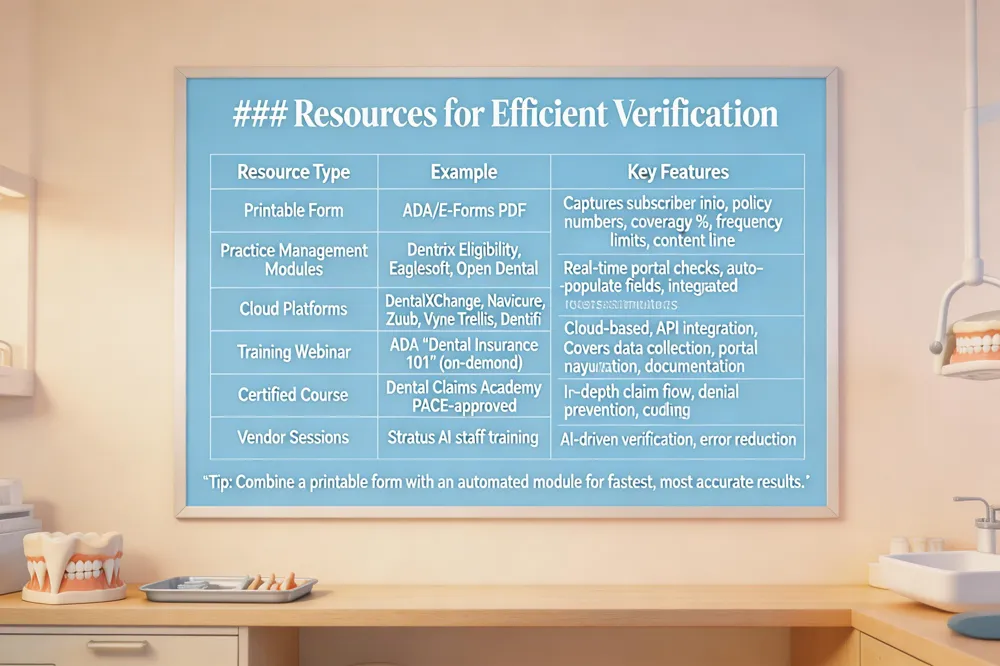 A printable dental insurance verification form is a staple for most practices. The American Dental Association, eForms, and many practice‑software vendors offer free PDF templates that capture subscriber details, policy numbers, coverage percentages, frequency limits, and a patient‑consent signature line. Offices can print, hand‑fill, or complete the form electronically and save it as a PDF for their records, ensuring consistent data collection and faster insurer communication.
Common verification software options include built‑in eligibility modules in Dentrix, Eaglesoft, and Open Dental, as well as cloud‑based platforms such as DentalXChange, Navicure, and emerging SaaS tools like Zuub, Vyne Trellis, and Dentifi. These solutions provide real‑time portal checks, automated data entry, and integrated cost‑estimate generation, reducing manual errors and speeding up cash flow.
Training resources are widely available. The ADA’s on‑demand "Dental Insurance 101" webinar, Dental Claims Academy’s PACE‑approved course, and vendor‑provided sessions (e.g., Stratus AI) teach front‑office staff how to collect the right information, navigate payer portals, and document verification results. These low‑cost or free programs can be accessed online at any time, helping teams stay current on ever‑changing dental benefit rules.
Patient Empowerment: Verifying Coverage Yourself
Patient‑Side Verification Checklist
| Action | Required Info | Tips |
|---|---|---|
| Present Insurance Card | Front & back images or physical card | Include insurer name, member ID, group #, contact phone |
| Capture Screenshot/Proof | Screenshot of portal result or call log with timestamp | Save as PDF, note staff name and date |
| Ask About Coverage Details | Insurer name, policy holder, patient ID, group ID, benefit limits, waiting periods, pre‑authorizations | Use payer’s online portal or member‑services hotline |
| Verify Network Status | Dentist’s in‑network designation for Loud Family Dental | Request written estimate of out‑of‑pocket cost |
| Remote Verification | Secure payer portal access (HIPAA‑compliant) | Enables staff to work from home and speeds up response |
Remember: Keep a personal copy of all verification records for future appointments.*
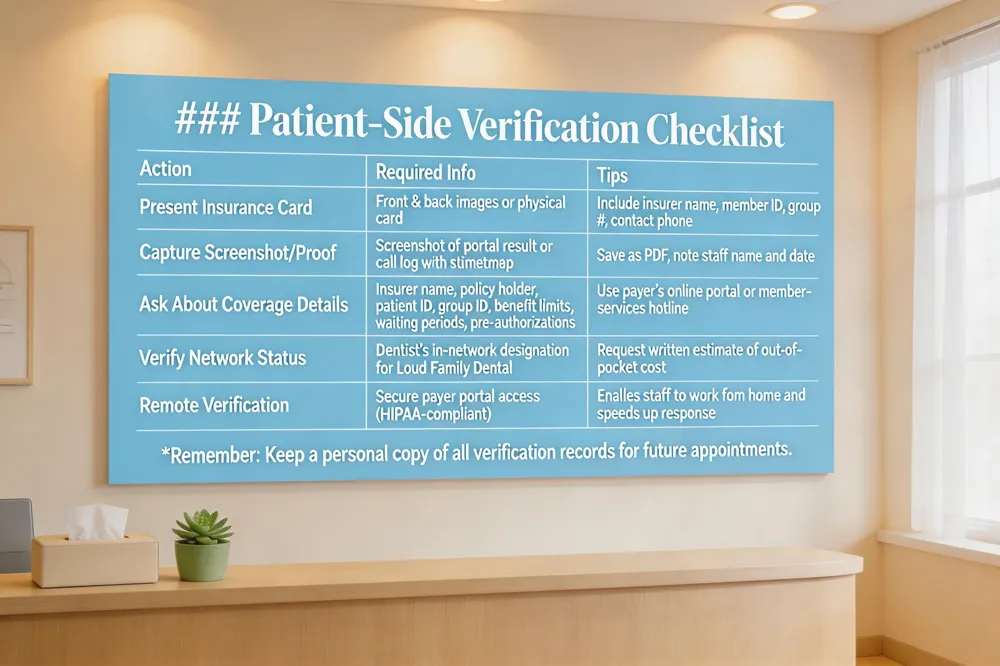 To prove you have dental insurance, simply present the front and back of your card, or a clear digital copy, to the dental office. The card lists the insurer name, policyholder, member ID, group number and a contact phone. Document verification interactions with screenshots, timestamps, or detailed notes reinforces the proof.
When you need to verify health insurance for a dental visit, gather your member ID, group number and insurer’s phone number, then either Check eligibility through payer’s online portal or toll‑free number or call the member‑services line. Ask specifically about dental benefits, in‑network status for Loud Family Dental, any waiting periods, and required pre‑authorizations. Keep a copy of the verification for your records.
The essential information required for a pre‑procedure check includes: insurer name, primary policyholder name and relationship, patient’s policy number, group ID (if applicable), and the insurer’s contact details.
Many dental billing firms now allow staff to work from home, using secure payer portals and HIPAA‑compliant systems to run eligibility checks remotely. This flexibility speeds up verification while maintaining accuracy.
Specialty Cases and Network Considerations
Specialty & Network Summary
| Insurance | Service | Waiting Period / Coverage | Notes |
|---|---|---|---|
| Delta Dental | Orthodontics (braces, aligners) | 12 months (major) – some plans offer immediate coverage (e.g., Ascent) | Waiver possible with employer‑sponsored plans |
| MetLife | Dental Implants | Covered as major procedure; ~50 % after deductible | May be excluded if classified as cosmetic; verify via MyBenefits |
| General In‑Network | Any covered service | Standard plan waiting periods apply | Higher % coverage, lower out‑of‑pocket |
| Out‑of‑Network | Any service | Often reduced rate or none; patient pays full fee | Ask dentist for written estimate; consider filing claim yourself |
Bottom line: Always confirm specific benefit booklet or carrier directly before scheduling specialty work.*
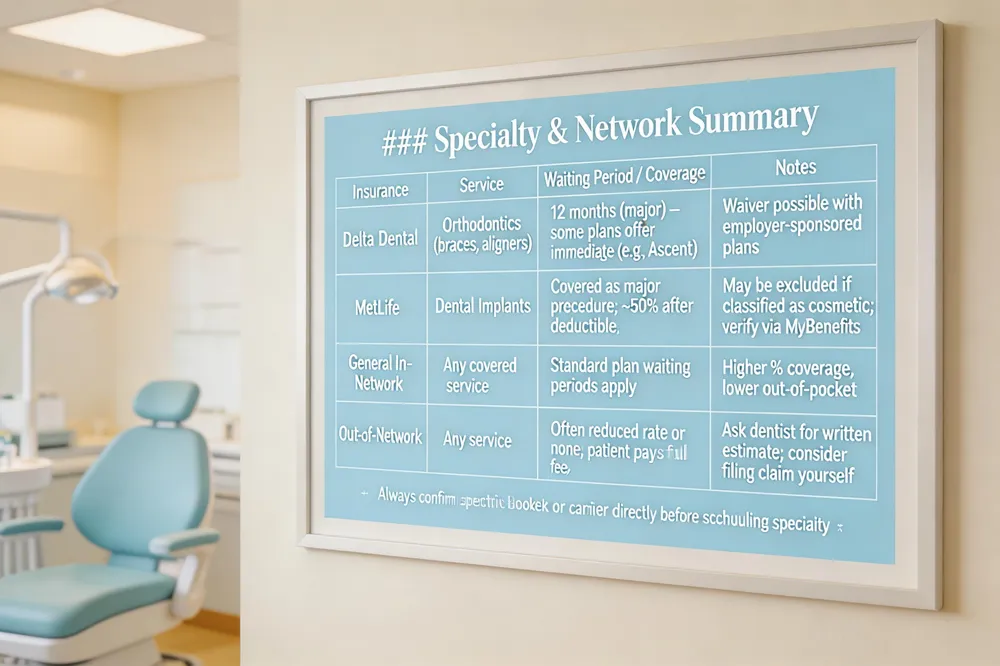 When you’re planning specialty dental work, understanding the nuances of your insurance can make a big difference in both cost and timing.
Does Delta Dental have a waiting period for orthodontic treatment? Most Delta Dental plans apply a waiting period before orthodontic services such as braces or clear aligners are covered, typically 12 months for major procedures. Some employer‑sponsored or individual plans may waive or shorten that period, and “no‑wait” options like the Delta Dental Ascent Plan provide immediate orthodontic coverage. Always check your specific benefit booklet or call the carrier to confirm the exact rules, because any orthodontic work performed before the waiting period ends will not be reimbursed.
Will MetLife dental insurance cover dental implants? Yes—MetLife generally includes implants as a major procedure, usually covering about 50 % of the allowable cost after your deductible and within your annual maximum. Coverage percentages can vary by plan, and some plans may label implants as cosmetic and exclude them. Verify your individual benefits through the MyBenefits portal or by contacting MetLife before scheduling.
Network status and out‑of‑network implications Selecting an in‑network dentist usually means higher coverage percentages and lower out‑of‑pocket costs. Out‑of‑network providers may be billed at a reduced rate or not at all, and you could be responsible for the full fee. When in doubt, ask the office to confirm their network status and request a written estimate of your financial responsibility.
Key Takeaways for Smooth Dental Care
Before any visit, confirm the patient’s dental coverage at least two‑to‑three days in advance. Collect the name, DOB, member ID, group number and a copy of the insurance card, then check the insurer’s online portal or call the toll‑free number to verify active status, effective dates, annual maximum, deductible balance and any required pre‑authorizations. Use a template or an automated verification platform—such as a practice‑management eligibility tool or a third‑party service like Delta Dental Provider Tools—to capture each data point and log the date, time and representative name. Finally, review plan‑specific rules: note waiting periods for major work, confirm the dentist is in‑network, and understand frequency limits or downgrade clauses so patients receive cost estimates and avoid surprise bills.