Introduction
Restorative dentistry restores damaged or missing teeth, giving patients a healthier smile and functional bite. From crowns that cap a weakened tooth, to bridges that span gaps, and implants that replace roots, each option addresses a specific need. At Loud Family Dental we recognize that every mouth is unique, so we tailor treatment plans based on the tooth’s condition, bone health, aesthetic goals, and budget. Our team works closely with Shreveport residents, offering free screenings at community health fairs and flexible financing to make quality care accessible. By combining the latest technologies with a personal, compassionate approach, we help each patient achieve lasting oral health and confidence. We also educate patients on daily oral‑hygiene habits to protect their restorations for years to come.
Crown, Bridge, and Implant Fundamentals
| Restoration | Typical Materials | Aesthetic Strengths | Longevity (good hygiene) | Typical Cost (USD) | Typical Indication |
|---|---|---|---|---|---|
| Crown | Porcelain, Zirconia, Metal‑Ceramic, All‑Metal | Porcelain/Zirconia = lifelike translucency; Metal = strength | 10‑15 years | $800‑$1,500 | Single damaged tooth needing structural reinforcement |
| Bridge | Same as crowns (porcelain, zirconia, metal‑ceramic) | Shade‑matched to adjacent teeth | 8‑15 years | $2,000‑$3,000 (three‑unit) | One or more missing teeth, adjacent teeth healthy enough to be prepared |
| Implant | Titanium post + Abutment + Porcelain/Zirconia crown | Natural look, preserves bone | 20‑30 years or lifetime | $3,000‑$6,000 (single) | Missing tooth when bone volume sufficient and patient healthy |
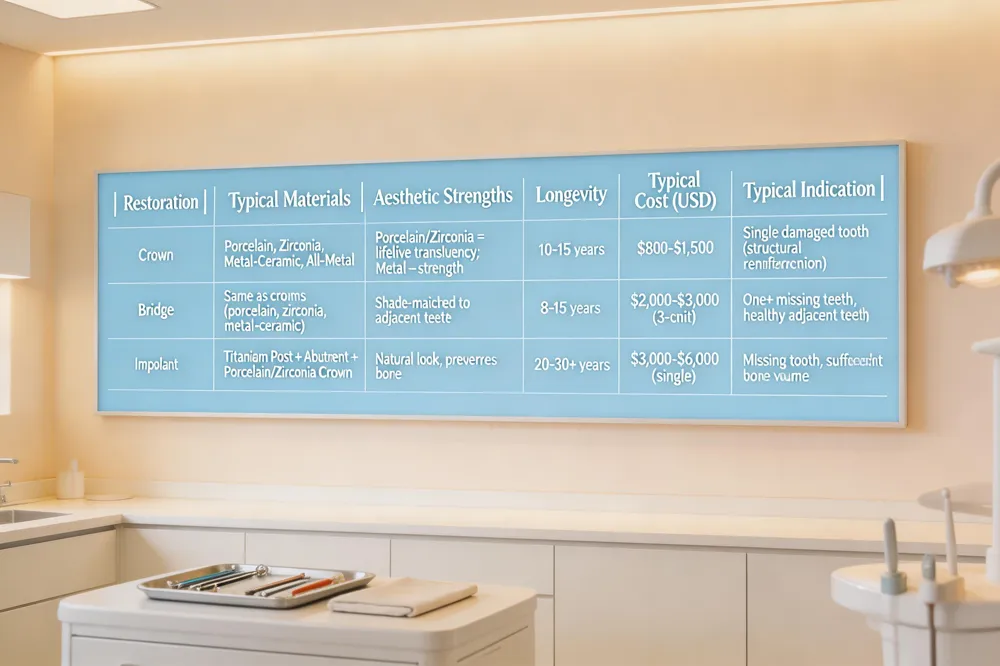 A dental crown is a custom‑made cap that covers a damaged or treated tooth, restoring its shape, strength and appearance. It can be porcelain, zirconia or metal‑ceramic, chosen for durability or the natural translucency of front teeth. A dental bridge replaces one or more missing teeth by anchoring a false tooth (pontic) to crowns placed on the adjacent healthy teeth (or implants). Bridges can be made from the same materials as crowns and are designed to fill gaps while preventing neighboring teeth from shifting. A dental implant is a titanium post surgically placed into the jawbone, fusing with bone (osseointegration) to act as an artificial root. An abutment and a crown are then attached, providing a permanent, bone‑preserving replacement.
Material choices and aesthetics – Porcelain and all‑ceramic (zirconia) offer the most lifelike color and translucency for visible teeth, while metal‑ceramic or all‑metal crowns give extra strength for back‑of‑mouth restorations. Bridges and implants can use the same shade‑matched materials for seamless smiles.
Longevity and maintenance – With good oral hygiene, crowns last 10‑15 years, bridges 8‑15 years, and implants 20‑30 years or a lifetime. Regular cleanings, flossing (or floss threaders for bridges) and avoiding smoking help all restorations stay healthy.
Crown and bridge before and after – Before treatment, a cracked, discolored or missing tooth may cause discomfort and an uneven smile. After a crown or bridge, the tooth looks natural, the gap is closed, and chewing function is restored, giving a brighter, confident appearance.
Crown vs bridge vs veneer – A crown caps a single damaged tooth; a bridge spans a gap using adjacent teeth as anchors; a veneer is a thin shell bonded to the front of a tooth for cosmetic enhancement only. Choose based on whether you need structural reinforcement, gap closure, or purely aesthetic improvement.
Crown vs bridge vs implant price – A crown costs $800‑$1,500; a three‑unit bridge $2,000‑$3,000; a single implant (post, abutment, crown) $3,000‑$6,000. Implants have higher upfront cost but longest lifespan and preserve bone.
Crown and bridge front teeth – For front‑tooth repair, porcelain or zirconia crowns provide a natural look when the tooth is present; a bridge can replace a missing front tooth using the same tooth‑matched materials, ensuring seamless aesthetics and function.
Cost, Insurance, and Financing Overview
| Treatment | Cost Range (USD) | Insurance Coverage | Financing Options |
|---|---|---|---|
| Traditional three‑unit bridge | $2,000‑$3,000 | Often partially covered; varies by plan | In‑house plans, third‑party lenders, HSAs/FSAs/HRAs |
| Single‑tooth implant | $3,000‑$6,000 | Usually limited; may cover extractions, bone grafts, surgical placement | Same as bridge |
| Full‑mouth implant (All‑on‑4/6) | $15,000‑$30,000 per arch | Rarely fully covered; may reimburse components | HSAs/FSAs, financing, payment plans |
| Regional example – Louisiana crown | $1,000‑$1,500 | Varies | Same as above |
| Regional example – Kansas implant | $3,500‑$6,500 | Varies | Same as above |
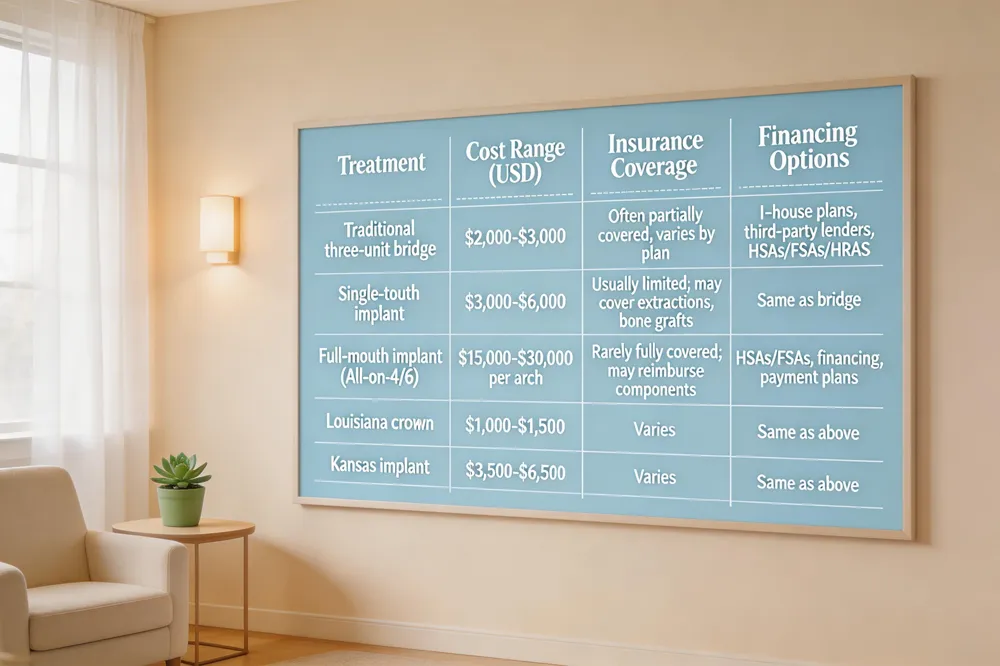 When deciding between a crown, bridge, or implant, understanding the financial landscape is essential. A traditional three‑unit bridge typically costs between $2,000 and $3,000, while a single‑tooth implant ranges from $3,000 to $6,000. Full‑mouth implant solutions can exceed $20,000, often approaching $30,000‑$60,000 for All‑on‑4 or full‑arch restorations. Insurance coverage varies: many plans cover a portion of bridge work, but implants are frequently classified as cosmetic and receive limited reimbursement. However, dental insurers may subsidize extractions, bone grafts, or the surgical placement of implants; always verify benefits before treatment. Financing options include in‑house payment plans, third‑party lenders, and tax‑advantaged accounts such as HSAs, FSAs, or HRAs. Regional pricing differences are notable—Louisiana crowns average $1,000‑$1,500, Kansas implants $3,500‑$6,500, and Wichita implants $3,000‑$7,000. For a single‑tooth implant, the national average is about $2,143, with crowns adding $488‑$3,254. At Loud Family Dental, we work with insurers and offer flexible financing to help you achieve a healthy, confident smile without compromising your budget.
Clinical Decision Factors and Alternatives
| Decision Factor | Impact on Choice | Alternative When Unfavorable |
|---|---|---|
| Bone health & volume | Sufficient bone → implant; insufficient → bridge or denture | Bone grafting, mini‑implants, removable partial denture |
| Gum disease | Active disease → postpone implant, consider bridge or denture | Periodontal therapy before definitive restoration |
| Lifestyle (smoking, diabetes, hygiene) | High risk → avoid surgery, favor crowns/bridges | Improved oral hygiene, cessation programs before implant |
| Adjacent tooth condition | Healthy teeth → bridge possible; compromised → implant or removable prosthesis | Resin‑bonded (Maryland) bridge, flipper denture |
| Aesthetic priority | Front‑tooth restoration → porcelain/zirconia crown or implant | No or veneer for minimal cosmetic change |
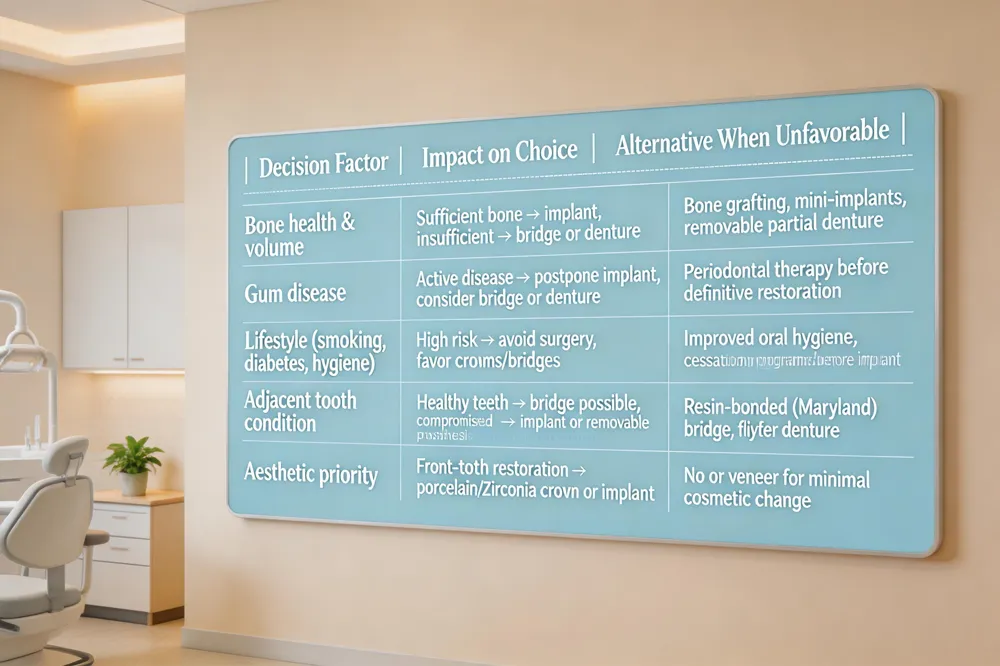 When choosing a restoration, dentists weigh bone health, gum disease, lifestyle, and aesthetics. Adequate bone and healthy gums are essential for implants; insufficient bone may require grafting or make a bridge a safer choice. Active smokers, uncontrolled diabetes, or poor oral hygiene can also steer patients away from surgery toward crowns or bridges.
Patients who prioritize a natural look and long‑term durability often favor implants, especially for front teeth where preserving adjacent tooth structure matters. Bridges are quicker and less costly but involve grinding down healthy neighboring teeth, which can weaken them over time.
If a bridge isn’t feasible—due to missing or compromised abutment teeth, severe bone loss, or a desire to avoid altering adjacent teeth—alternatives include removable partial dentures, flipper dentures, or resin‑bonded (Maryland) bridges, all of which are more budget‑friendly.
Implant recommendations: when bone volume is sufficient and the patient is in good systemic health, a titanium implant with a porcelain crown offers the most durable, bone‑preserving solution, often lasting a lifetime with proper care. At Loud Family Dental we evaluate each factor to tailor the optimal restoration for your smile.
Temporary and DIY Solutions
| Temporary Solution | Description | Typical Duration | Main Risks |
|---|---|---|---|
| Flipper denture | Acrylic retainer with a prosthetic tooth that snaps onto neighboring teeth | Weeks to a few months | Poor fit, bite instability, tissue irritation |
| OTC missing‑tooth kit (e.g., Temptooth) | Home‑molded biodegradable material that hardens quickly | Hours to days | Inaccurate fit, bacterial trapping, limited strength |
| Professional temporary partial denture | Lab‑fabricated denture for short‑term use | Weeks to months | Similar to flipper but better fit; still temporary |
| DIY wax or polymer bead filler | Improvised material placed in socket | Immediate, very short‑term | Infection, damage to surrounding teeth, no functional restoration |
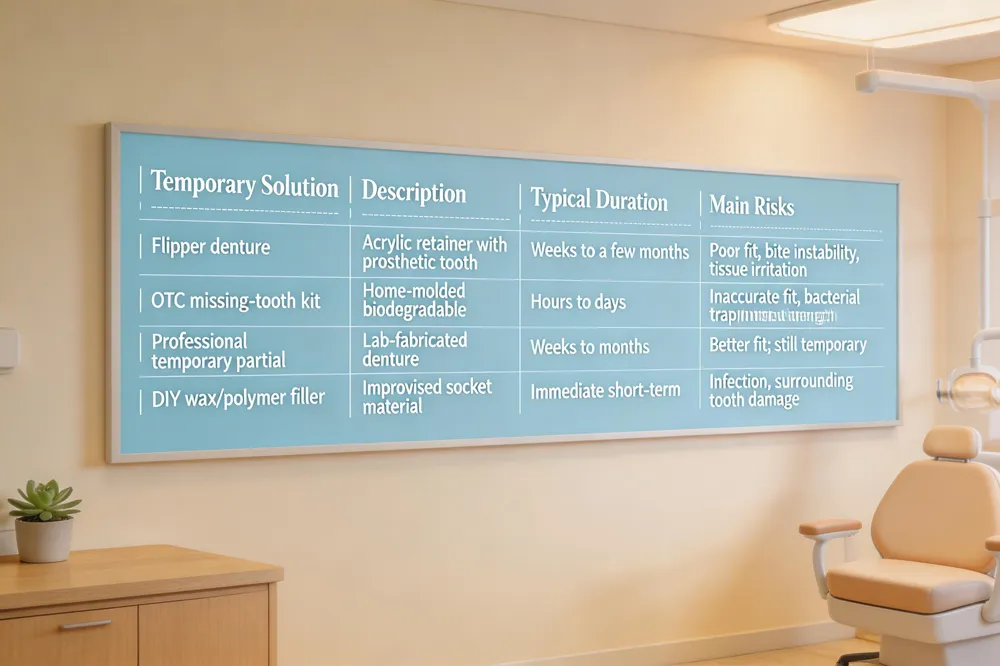 When a tooth goes missing, many patients look for quick fixes before a permanent crown, bridge, or implant can be placed.
Flipper dentures are lightweight acrylic retainers with a prosthetic tooth that snaps onto neighboring teeth; they restore appearance and basic function for a few weeks to months and are easy to adjust.
Over‑the‑counter kits (e.g., Temptooth or other missing‑tooth replacement kits) let you mold a temporary tooth at home using a safe, biodegradable material that hardens in minutes. While convenient, these kits provide only a short‑term solution and may not fit as precisely as a dentist‑fabricated restoration.
Short‑term fixes such as a professionally made flipper or a temporary partial denture can bridge the gap while you plan definitive treatment. Keep the area clean with gentle brushing and salt‑water rinses, and stick to soft foods to avoid dislodging the temporary tooth.
Risks of DIY treatments include bacterial trapping, infection, improper bite forces, and accelerated bone loss. DIY methods like melted polymer beads or wax do not restore proper function and can damage adjacent teeth.
$399 dental implants usually cover only the titanium post, excluding the abutment, crown, imaging, bone grafts, and follow‑up care; total costs typically rise to $3,000‑$5,000.
Temporary missing tooth replacement options such as flippers or professional temporary dentures are safe interim solutions, but schedule a definitive appointment promptly.
How to replace a missing tooth yourself – it is not advisable; consult a dentist for a personalized plan.
Missing tooth replacement kit – offers a quick, inexpensive fix but is not a permanent substitute; a professional evaluation ensures lasting health and aesthetics.
Advanced and Full‑Mouth Treatment Options
| Treatment | Cost Range (USD) | Components Included | Typical Use |
|---|---|---|---|
| Full‑mouth implants (per arch) | $15,000‑$30,000 | Implants (4‑6), abutments, full‑arch prosthesis | Complete edentulism, desire for fixed solution |
| Single‑tooth implant | $3,000‑$7,000 | Titanium post, abutment, custom crown, diagnostics | Isolated missing tooth with adequate bone |
| All‑on‑4 (fixed full‑arch) | $20,000‑$30,000 per arch | Four implants, prosthetic bridge, occasional bone graft | Full‑arch restoration with fewer implants |
| 3‑tooth implant‑supported bridge | $5,000‑$15,000 (average $9,000‑$12,000 locally) | 3 implants, bridge framework, crowns | Multiple adjacent missing teeth, limited bone |
| Mini‑dental implants (supporting removable prosthesis) | $1,500‑$3,000 per implant | Mini implant, attachment system, removable denture | Limited bone height, cost‑conscious patients |
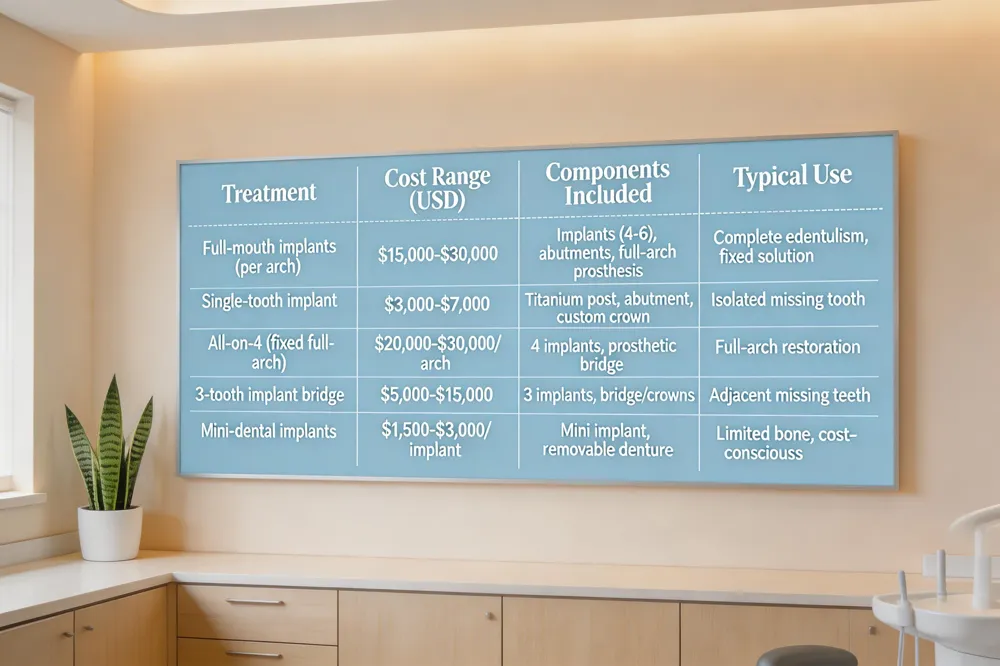 Full‑mouth dental implants cost without insurance
 typically range from $15,000 to $30,000 per arch, with many patients seeing a cost of about $20,000‑$30,000 for a fixed‑arch restoration. Insurance rarely covers the entire procedure, but it may reimburse extractions, bone grafts, or surgical placement. Health Savings Accounts (HSAs), Flexible Spending Accounts (FSAs) and in‑house financing can help offset out‑of‑pocket expenses.
Full‑mouth dental implants cost without insurance
Full‑mouth dental implants cost without insurance typically range from $15,000 to $30,000 per arch, with many patients seeing a cost of about $20,000‑$30,000 for a fixed‑arch restoration. Insurance rarely covers the entire procedure, but it may reimburse extractions, bone grafts, or surgical placement. Health Savings Accounts (HSAs), Flexible Spending Accounts (FSAs) and in‑house financing can help offset out‑of‑pocket expenses.
Single tooth implant cost without insurance A single‑tooth implant without insurance usually costs $3,000‑$7,000. This includes the titanium post ($1,500‑$2,500), the abutment and custom crown ($1,000‑$2,000) and diagnostic work ($500‑$1,000). High‑quality materials and expert placement increase durability, often lasting 20 years or more, making it a cost‑effective long‑term choice compared with bridges that need periodic replacement.
All‑on‑4 and implant‑supported bridges All‑on‑4 uses only four implants to anchor a full‑arch bridge, often eliminating the need for extensive bone grafting. Implant‑supported bridges can replace multiple missing teeth with a series of implants, preserving bone and avoiding the preparation of healthy teeth required by traditional bridges.
3‑tooth implant bridge cost A three‑unit implant‑supported bridge is typically $5,000‑$15,000. In Shreveport, Loud Family Dental reports an average out‑of‑pocket cost of $9,000‑$12,000 after insurance discounts. Financing, HSA/FSA reimbursements, and payment plans further reduce the upfront cost.
Missing tooth replacement options Options include:
- Dental crowns (for damaged but present teeth)
- Traditional bridges (anchor to adjacent crowns)
- Implant‑supported crowns or bridges (no alteration of neighboring teeth)
- Partial or complete dentures (removable, lower cost)
- All‑on‑4 / All‑on‑6 (fixed full‑arch solutions with fewer implants)
- Mini‑dental implants (support removable prosthetics when bone is limited)
Your dentist will assess bone health, budget, and aesthetic goals to recommend the best solution.
Conclusion
Key takeaways: Dental crowns protect damaged teeth, bridges fill gaps using adjacent teeth, and implants replace missing teeth while preserving bone and neighboring structures. Crowns last 10‑15 years, bridges 8‑15 years, and implants can last 20‑30 years or a lifetime with proper care. Next steps for patients: Schedule a comprehensive exam at Loud Family Dental to evaluate tooth health, bone density, and aesthetic goals. Discuss your budget, insurance coverage, and financing options to determine the most suitable restoration. Our team will create a personalized treatment plan, explain the procedure timeline, and answer any questions about maintenance. Contact Loud Family Dental today at (318) 555‑1234 or visit our website to book your appointment and start your journey toward a healthier, brighter smile.