Introduction
Orthodontic treatment offers several pathways to a healthier, more confident smile, the most common options being traditional metal braces and clear aligner therapy. Selecting the right appliance is more than a cosmetic decision; it directly influences treatment length, comfort, oral‑hygiene routines, and overall satisfaction. Adults and teens alike weigh factors such as the severity of malocclusion, lifestyle preferences, aesthetic concerns, and budget when deciding between a fixed bracket system and removable, virtually invisible trays. Clinical evidence shows that clear aligners often provide shorter treatment times, lower discomfort, and higher patient‑reported satisfaction for mild to moderate cases, while braces remain the gold standard for complex movements and severe bite problems. Understanding these nuances helps patients collaborate with their orthodontist to craft a personalized plan that aligns with both clinical needs and personal priorities.
Pros and Cons of Braces and Aligners
Pros & Cons – Braces vs. Aligners
| Aspect | Braces (Traditional Metal) | Aligners (Clear) |
|---|---|---|
| Effectiveness for severe cases | ★★★★★ – Handles severe crowding, large gaps, complex bite corrections with continuous force. | ★★☆☆☆ – Limited for severe rotations, large gaps, or complex bite issues. |
| Visibility | ❌ Visible; can affect self‑confidence. | ✅ Virtually invisible. |
| Comfort | ⚡ May cause soft‑tissue irritation from brackets/wires. | ✅ Smooth plastic; lower discomfort scores (2.3/10). |
| Dietary restrictions | ❌ Must avoid sticky, hard foods. | ✅ Removable—no restrictions. |
| Compliance reliance | ❌ Relies on orthodontist adjustments only; no daily patient effort. | ✅ Requires 20‑22 h/day wear; non‑compliance can extend treatment. |
| Treatment duration (mild‑moderate) | 12‑18 months. | 6‑12 months (faster if compliant). |
| Cost (average) | $3,000‑$7,000. | $4,000‑$8,000 (often slightly higher). |
| Oral hygiene | Requires special brushes & floss threaders. | Normal brushing/flossing while aligners are removed. |
| n **** | ulatory ❌ Fewer in‑office visits. | ✅ Fewer visits (every 6‑10 weeks). |
| ** | Hygiene | |
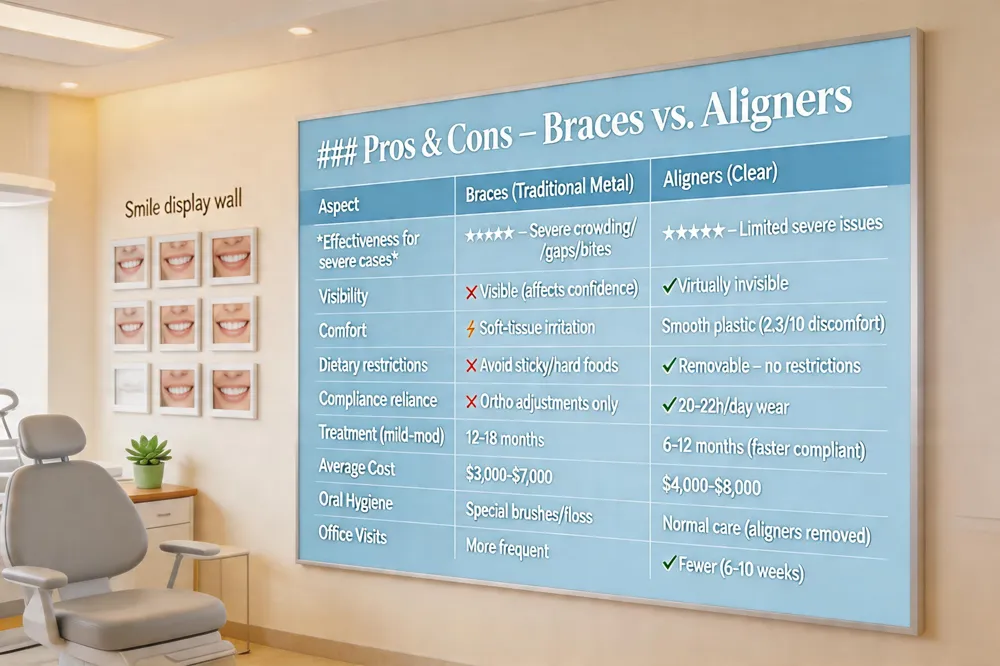 Traditional metal braces remain the gold standard for complex orthodontic problems. They can address severe crowding, large gaps, and significant bite issues with continuous force, eliminating the need for patient‑‑pliance. Braces are generally less expensive for severe corrections and require no daily wear discipline. However, they are highly visible, impose dietary restrictions, and often cause soft‑tissue irritation from brackets and wires. Maintenance is more demanding, requiring special brushes and floss threaders to prevent plaque buildup.
Clear aligners offer a contrasting set of advantages. Made from smooth, medical‑grade plastic, they are virtually invisible, removable for meals, and allow normal brushing and flossing, which improves oral hygiene and reduces food‑related emergencies. Patients typically enjoy fewer in‑office visits and report higher comfort scores (2.3 ± 1.1 vs. 5.6 ± 1.8 for braces) and greater aesthetic satisfaction (9.2 ± 0.8 vs. 6.5 ± 1.2). The main drawbacks are the strict requirement to wear them 20–22 hours per day, which can extend treatment if compliance lapses, and limited effectiveness for severe rotations, large gaps, or complex bite corrections. Aligners also tend to cost more than traditional braces for comparable cases, though insurance may offset part of the expense.
Traditional Braces for Adult Patients
Traditional Braces – Adult Patient Overview
| Parameter | Typical Values |
|---|---|
| Treatment duration | 18‑36 months (depends on case severity). |
| Cost | $3,000‑$7,000 (often comparable to aligners). |
| Aesthetic options | Metal (most visible) or ceramic/clear brackets (more discreet, higher price). |
| Compliance | Fixed appliance – no daily wear discipline required. |
| Dietary restrictions | Must avoid sticky, hard, and very crunchy foods. |
| Office visits | Regular adjustments every 4‑6 weeks. |
| Oral hygiene challenges | Requires special brushes, floss threaders, and diligent plaque control. |
| Patient suitability | Ideal for severe malocclusions, large gaps, major bite corrections, and complex rotations. |
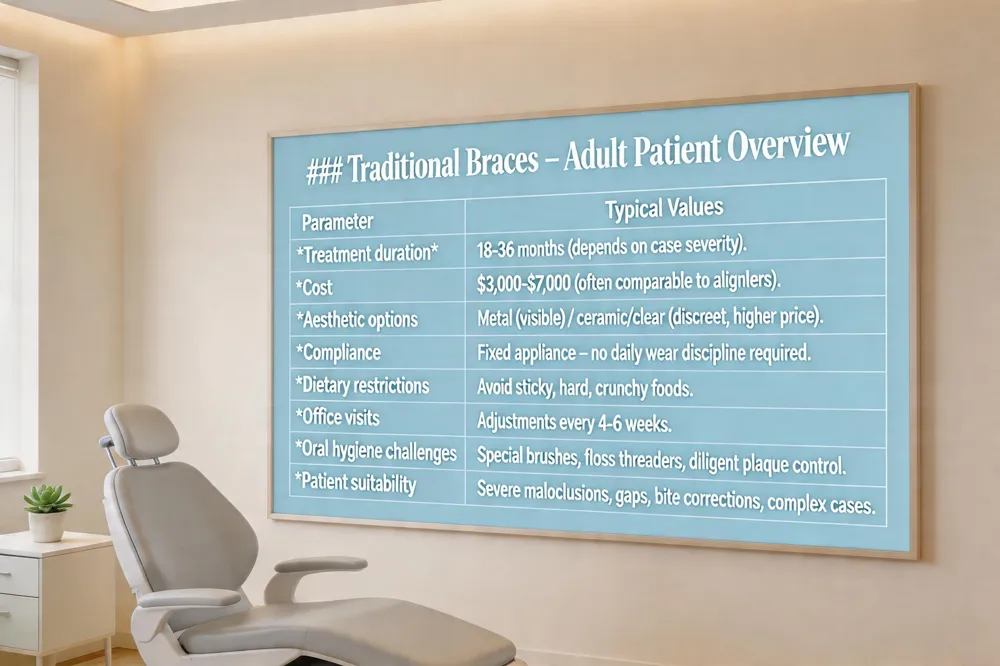 Traditional metal braces remain the gold standard for adult patients who need robust control of complex tooth movements, such as severe crowding, large gaps, major bite corrections, and significant rotations. Because the brackets and archwire are fixed, continuous forces are applied without relying on patient compliance, making them especially reliable for intricate cases.
Typical treatment duration for adult braces ranges from 18 to 36 months, depending on case severity. The cost is generally $3,000‑$7,000, which is comparable to clear aligners that run $4,000‑$8,000; both are often partially covered by dental insurance.
Aesthetically, metal braces are noticeable, which can affect self‑confidence, though ceramic or clear brackets can soften the visual impact at a higher price. Adults seeking a discreet look usually prefer clear aligners, which are virtually invisible and removable for eating and oral hygiene.
Traditional braces vs clear aligners for adults – Braces excel in handling severe malocclusions and provide continuous force without wear‑time discipline, while clear aligners offer greater comfort, aesthetic appeal, and dietary freedom but work best for mild‑to‑moderate issues and require diligent 20‑22 hour daily wear. Cost differences are modest, so the decision often hinges on treatment complexity, lifestyle preferences, and aesthetic priorities.
Clear Aligners: Adult Benefits
Clear Aligners – Adult Benefits
| Benefit | Description |
|---|---|
| Aesthetic discretion | Virtually invisible; ideal for professional and social settings. |
| Comfort | Smooth, medical‑grade plastic eliminates bracket irritation; average discomfort score 2.3/10. |
| Removability | Can be taken out for meals and oral hygiene, allowing normal brushing/ flossing. |
| Digital workflow | 3‑D scanning & AI‑powered planning gives predictable 12‑18 12 timeline for mild‑to‑moderate cases. |
| Fewer office visits | Typically one appointment every 6‑10 weeks. |
| Lifestyle flexibility | No dietary restrictions; patients can eat any food. |
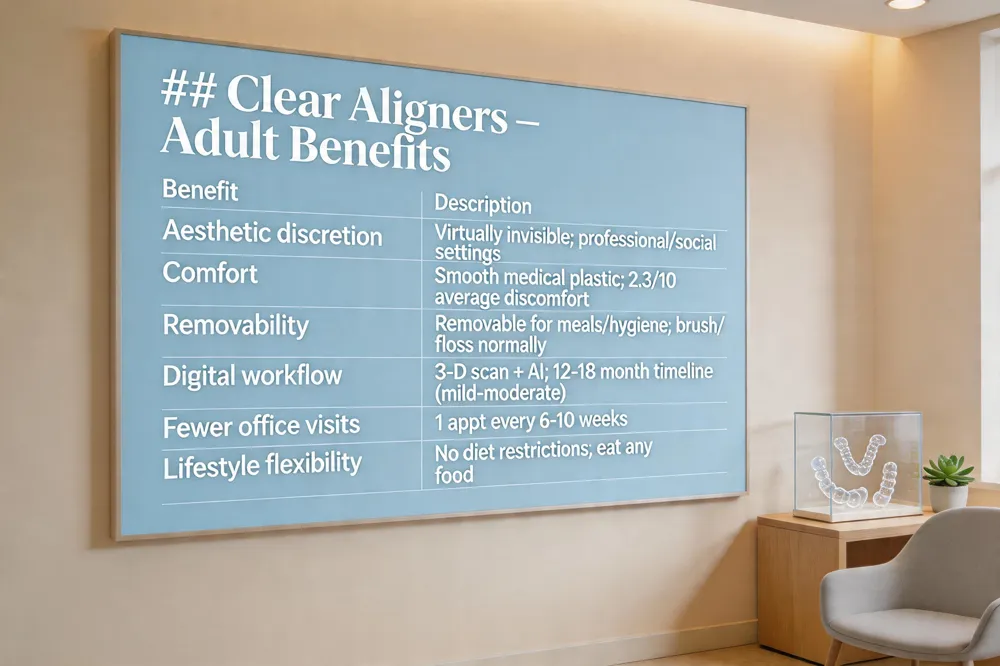 Clear aligners have become the go‑to orthodontic choice for adults who want a discreet, comfortable, and convenient way to straighten their teeth. Because the trays are made of smooth, medical‑grade plastic, they are virtually invisible, allowing adults to maintain a professional appearance in the office and social settings without the conspicuous brackets and wires of traditional braces.
Comfort is another major advantage. The custom‑fit trays eliminate the metal brackets that can irritate cheeks and gums, resulting in lower discomfort scores (average 2.3 on a 0‑10 scale) compared with braces. Since the aligners are removable, patients can eat any foods they like and brush or floss normally, which reduces plaque buildup and the risk of cavities during treatment.
Digital treatment planning, using 3‑D scans and AI‑powered software, creates a precise, predictable timeline—often 12‑18 months for mild to moderate cases—and requires fewer in‑office appointments (typically every 6‑10 weeks). This fits easily into busy adult schedules and minimizes time away from work or family.
Overall, clear aligners combine aesthetic discretion, superior comfort, removable flexibility, and efficient digital workflows, making them an ideal orthodontic option for adults.
Speed of Treatment: Aligners vs. Braces
Speed of Treatment Comparison
| Case Complexity | Aligners (Typical) | Braces (Typical) |
|---|---|---|
| Mild‑moderate malocclusion | 6‑12 months (digital sequencing). | 12‑18 months (continuous force). |
| Moderate (some rotations, medium gaps) | 12‑18 months (may need refinements). | 12‑18 months (steady progress). |
| Severe (large gaps, major bite, complex rotations) | 18‑24 months **often requires auxiliaries or switch to braces). | 18‑24 months (more efficient due to fixed force). |
| Compliance impact | Highly dependent on 20‑22 h/day wear; non‑compliance extends time. | Minimal patient effort; continuous force irrespective of compliance. |
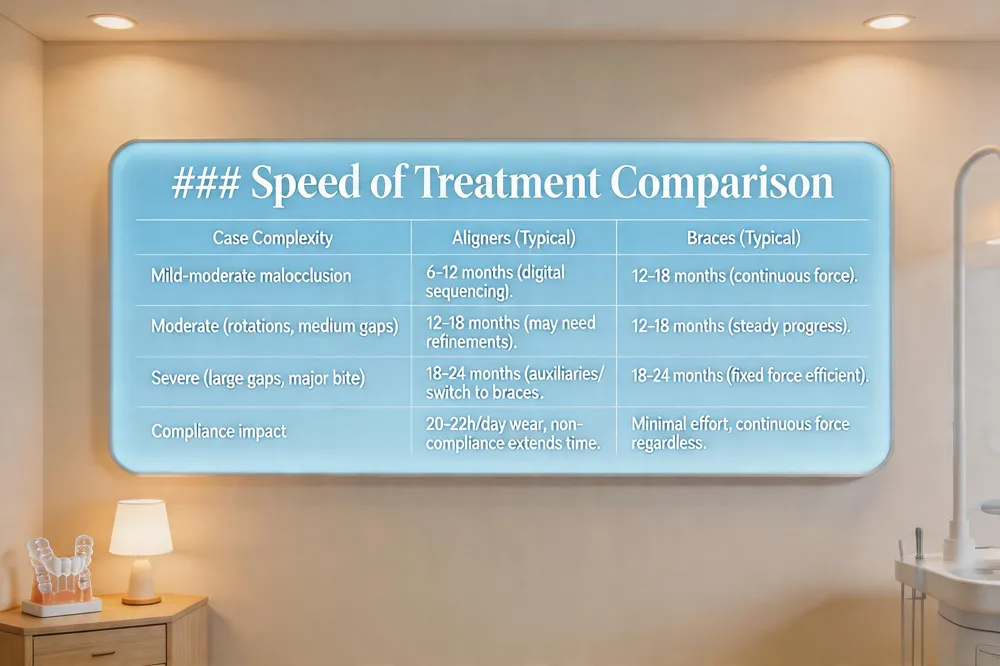 For mild to moderate malocclusions, clear aligners typically finish in 6‑12 months, whereas conventional metal braces usually require 12‑18 months. This modest advantage reflects the fact that aligner treatment is planned digitally and each tray moves teeth only a few tenths of a millimeter, allowing a rapid sequence of changes when the patient follows the prescribed wear schedule.
Patient compliance is a decisive factor. Aligners must be worn 20‑22 hours per day; missed wear time can extend the overall duration or compromise the final result. Braces, by contrast, provide continuous force without relying on daily patient action, which can make them more reliable for those who struggle with strict wear protocols.
In complex cases—severe crowding, large gaps, major bite corrections, or significant tooth rotations—braces remain the more efficient option. Their fixed brackets and wires can achieve three‑dimensional movements that aligners may require additional attachments, refinements, or even a switch to braces.
Answer to the question “Aligners vs braces which is faster?” For simple to moderate malocclusions, clear aligners often finish in 6‑12 months, slightly faster than Traditional metal braces that usually take 12‑18 months. In more complex cases requiring extensive tooth movement or bite correction, braces are generally more efficient, with treatment lasting 18‑24 months. Aligners rely on patient compliance—wearing them 20‑22 hours daily—so if the patient is diligent they may be quicker; braces work continuously without the patient’s active participation. Both methods use gentle, consistent pressure, and modern digital planning can further reduce treatment time for either option. Overall, the faster option depends on the specific orthodontic needs, age, and how consistently the appliance is used.
Common Challenges and Limitations of Aligners
Common Aligners Challenges & Limitations
| Challenge | Details |
|---|---|
| Patient compliance | Must be worn 20‑22 h/day; missed wear slows movement. |
| Effectiveness for large gaps/rotations | Limited to ~5‑6 mm closures; severe cases may need attachments, auxiliaries, or adjunctive procedures. |
| Risk of loss/damage | Removable trays can be misplaced or broken, incurring additional cost. |
| Higher cost for complex cases | Often more expensive than braces for comparable severity. |
| Limited control for complex bite corrections | Brackets and wires provide three‑dimensional precision that aligners may lack. |
| Discomfort during tray change | Initial pressure of new tray can be uncomfortable, leading some patients to discontinue. |
| Financial burden | Series of trays (20‑30) plus possible refinements increase total expense. |
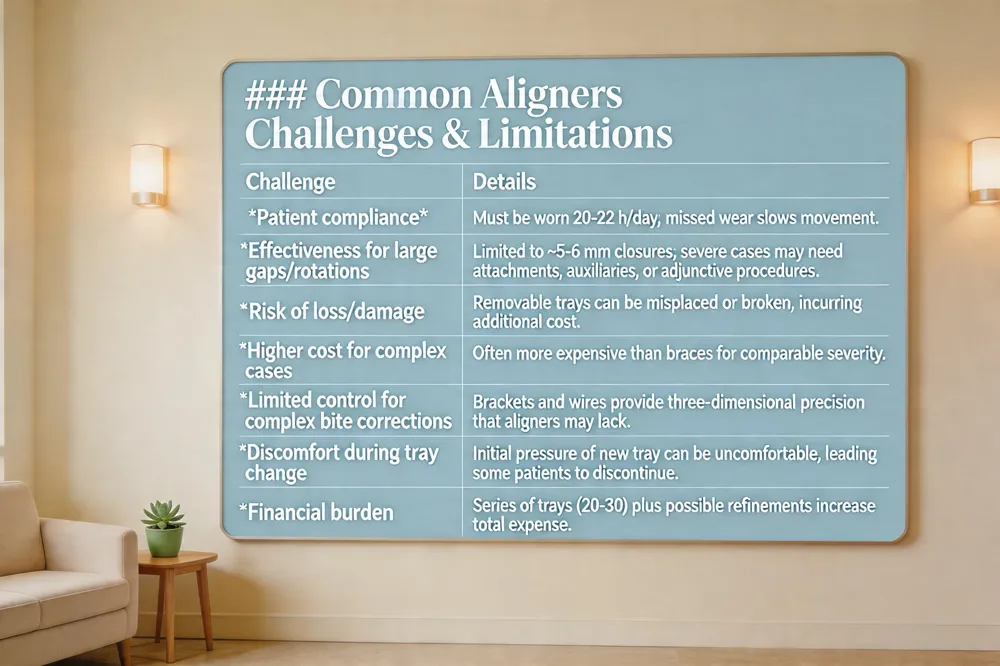 When considering clear‑aligner therapy, patients often encounter several hurdles that can influence the success of treatment.
Patient compliance issues – Aligners must be worn 20‑22 hours each day; missing even a few hours can slow tooth movement and extend the overall timeline. Consistent wear is especially challenging for busy adults, frequent travelers, or those involved in contact sports.
Why people quit Invisalign – Many discontinue because the strict wear schedule feels restrictive, or because the initial pressure of a new tray causes discomfort that discourages continued use. Unrealistic expectations—such as hoping for rapid results—can lead to disappointment, while the cumulative cost of the series of trays and the need for diligent cleaning may become financially or logistically burdensome.
Effectiveness for closing gaps – Clear aligners are quite capable of closing small to moderate spaces (up to about 5‑6 mm) by applying gentle, controlled forces. Attachments or auxiliary devices can enhance traction when needed. Larger gaps or those linked to missing teeth often require adjunctive procedures, such as temporary anchorage devices or restorative work, because aligners alone may not provide enough force.
Overall disadvantages compared with traditional braces – Aligners demand high discipline, are less suited for severe rotations, large gaps, or complex bite problems where brackets and wires give more precise control. While they offer aesthetic and hygiene benefits, the removable nature can lead to lost or damaged trays, and some patients find the continuous need to remember to put them back after meals cumbersome. In contrast, traditional braces stay affixed, eliminating wear‑time compliance concerns but requiring dietary restrictions and more frequent office visits for adjustments.
Ultimately, the decision hinges on the individual’s orthodontic needs, lifestyle, and willingness to follow the prescribed wear schedule. A thorough evaluation at Loud Family Dental will pinpoint whether aligners or braces are the optimal path for achieving a healthy, beautiful smile.
Financial Considerations & Long‑Term Maintenance
Financial & Long‑Term Maintenance Overview
| Aspect | Details |
|---|---|
| Cost range (braces) | $2,500‑$7,500 (≈$3,000‑$7,000 without insurance). |
| Cost range (aligners) | $3,000‑$8,000 (some brands $2,999 for mild cases). |
| Insurance coverage | Up to 50 % of fees or lifetime maximum $3,000‑$5,000 for both modalities. |
| Financing options | HSA/FSA funds, office payment plans (12‑60 months, low/zero down). |
| Retention after treatment | Removable or fixed retainers worn nightly, often indefinitely. |
| Long‑term maintenance | Regular dental check‑ups; lifelong retainer use prevents relapse. |
| Typical aligner series | 20‑30 trays for a two‑year course (1‑2 weeks per tray). |
| Post‑treatment costs | Retainer fabrication (≈$200‑$500) and occasional polishing. |
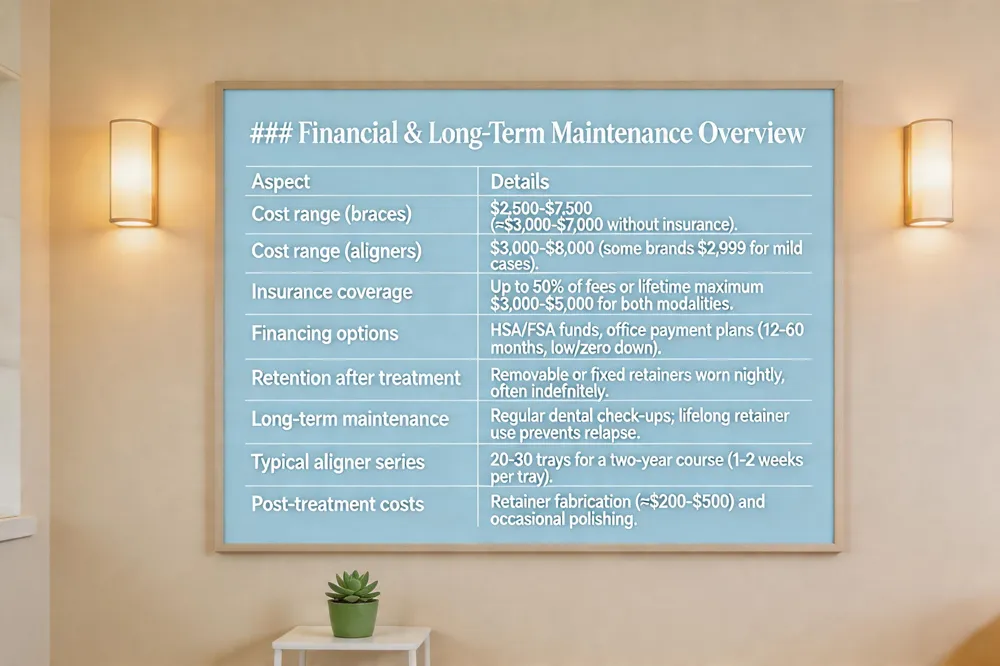 Typical price ranges for orthodontic appliances vary: metal braces usually run $2,500‑$7,500 (or $3,000‑$7,500 without insurance), while clear aligner therapy costs $3,000‑$8,000, with some brands offering a $2,999 option for mild cases. Most dental plans cover up to 50 % of the orthodontic fee or a lifetime maximum of $3,000‑$5,000, applying similarly to braces and Invisalign; checking your specific policy will reveal the exact out‑of‑pocket amount. A two‑year Invisalign course typically requires 20‑30 trays, based on a 1‑2‑week change schedule, though complex cases may need more. After active treatment, retention is essential: removable or fixed retainers are worn at night, often indefinitely, to prevent the natural tendency of teeth to shift over decades. Even 20 years after braces, bone remodeling and daily forces can cause movement, so lifelong retainer use and regular dental check‑ups help maintain the corrected smile. Financing options, HSA/FSA funds, and office‑provided payment plans can spread costs over 12‑60 months with low or zero down‑payment, making both braces and aligners accessible for most patients.
Conclusion
Choosing between clear aligners and traditional braces hinges on several personal priorities. Aesthetics favor the virtually invisible aligners, while braces are more noticeable. Comfort scores are higher for aligners, which lack brackets and wires that can irritate soft tissue. Treatment speed often leans toward aligners for mild‑to‑moderate cases, with studies showing a 1‑2‑month advantage. Cost ranges overlap, but insurance coverage and financing options can tip the balance. Finally, compliance is critical – aligners demand 20‑22 hours of daily wear, whereas braces work continuously without patient effort. Because each smile is unique, an orthodontist must evaluate bite, case complexity, lifestyle, and budget. Schedule a consultation at Loud Family Dental, Shreveport, to receive a customized treatment plan that aligns with your goals.