Why Discreet Orthodontics Matters for Professionals
Professionals spend many hours in front of screens, presentations and client meetings, so a straight, confident smile can influence first impressions. Clear aligners meet aesthetic expectations because the transparent trays are invisible, allowing adults to maintain an appearance throughout the day. Their nature adds convenience: trays can be taken out for meals, coffee breaks or calls, and oral hygiene stays routine without the restrictions of brackets. Proper alignment improves bite function, reduces gum irritation and lowers the risk of tooth wear, supporting oral health. The clear‑aligner market is expanding—valued at $3.5 billion in 2024 and projected to exceed $7 billion by 2033—driven by adult demand for discreet, comfortable solutions. Digital scanning, 3‑D planning and remote monitoring streamline workflows, cutting the number of in‑office visits and schedules.
Clear Aligners: Technology, Materials, and Top Brands
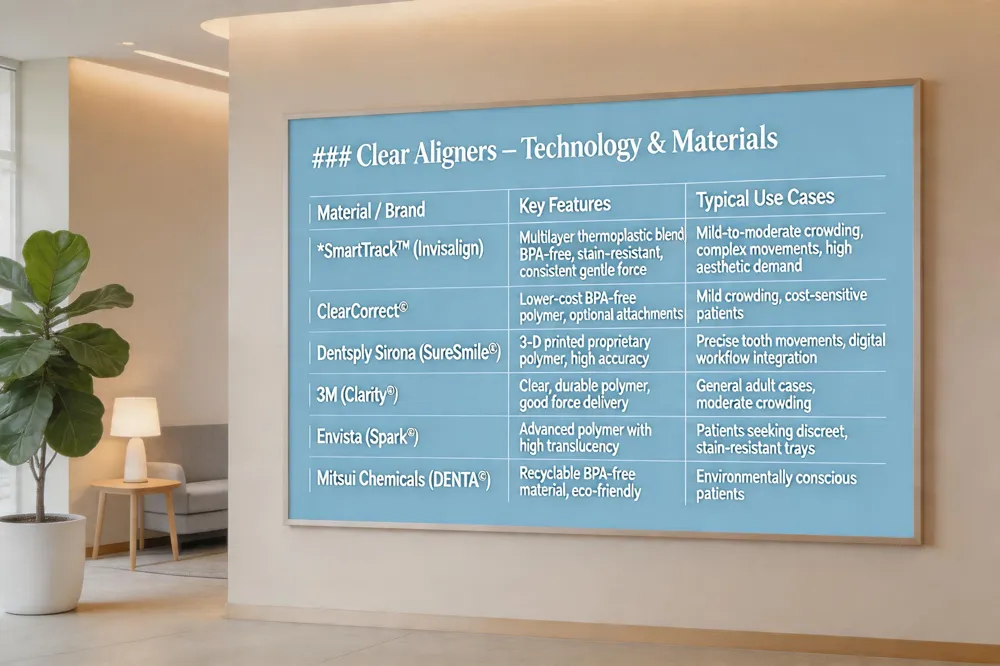
Clear Aligners – Technology & Materials
| Material / Brand | Key Features | Typical Use Cases |
|---|---|---|
| SmartTrack™ (Invisalign) | Multilayer thermoplastic blend, BPA‑free, stain‑resistant, consistent gentle force | Mild‑to‑moderate crowding, complex movements, high aesthetic demand |
| ClearCorrect® | Lower‑cost BPA‑free polymer, optional attachments | Mild crowding, cost‑sensitive patients |
| Dentsply Sirona (SureSmile®) | 3‑D printed proprietary polymer, high accuracy | Precise tooth movements, digital workflow integration |
| 3M (Clarity®) | Clear, durable polymer, good force delivery | General adult cases, moderate crowding |
| Envista (Spark®) | Advanced polymer with high translucency | Patients seeking discreet, stain‑resistant trays |
| Mitsui Chemicals (DENTA®) | Recyclable BPA‑free material, eco‑friendly | Environmentally conscious patients |
 Clear aligner therapy starts with a 3‑D digital scan or intra‑oral impression that captures every tooth and bite nuance. Using CAD/CAM software, orthodontists design a personalized treatment plan and then fabricate a series of custom trays—often by 3‑D printing BPA‑free polymers. Modern materials such as Invisalign’s SmartTrack™ and multilayer thermoplastic blends provide consistent, gentle force while staying virtually invisible and stain‑resistant.
Industry leaders include Align Technology (Invisalign), Dentsply Sirona, 3M, Envista Holdings, and Mitsui Chemicals, together controlling the majority of the fast‑growing market that was valued at $3.5 billion in 2024 and is projected to exceed $7 billion by 2033.
For crowded teeth, clear aligners are highly effective when the crowding is mild to moderate. Invisalign, with its SmartTrack material and optional attachments, is the top choice for moving teeth efficiently and maintaining aesthetic discretion. ClearCorrect offers a solid, lower‑cost alternative for less severe crowding.
Clear aligner technology – A 3‑D scan creates a digital model, which guides the production of a series of removable, BPA‑free trays that are worn 20‑22 hours daily and changed every 1–2 weeks. This removable design supports normal eating and oral hygiene while delivering predictable tooth movement.
Most popular clear aligner – Invisalign dominates the market, thanks to its robust digital workflow, extensive insurance coverage, and strong clinical outcomes.
Best clear aligners for crowded teeth – Invisalign leads for moderate to severe crowding due to its SmartTrack polymer and precise attachments; ClearCorrect is a viable option for milder cases.
Adult Orthodontic Options and Their Discretion
Adult Orthodontic Options – Visibility & Cost
| Option | Visibility | Typical Cost (USD) | Ideal Cases |
|---|---|---|---|
| Traditional Metal Braces | High (metallic) | $3,000‑$7,000 | Complex movements, severe malocclusions |
| Self‑Ligating Metal Braces | Medium‑high | $3,500‑$7,500 | Faster appointments, reduced discomfort |
| Ceramic Braces | Low‑medium (tooth‑colored) | $4,000‑$8,000 | Adults wanting discreet fixed appliances |
| Lingual Braces | Very low (behind teeth) | $5,000‑$9,000 | Maximum aesthetic demand, professional settings |
| Removable Clear Aligners (Invisalign, ClearCorrect) | Very low (transparent) | $3,500‑$7,500 | Mild‑to‑moderate crowding, lifestyle‑friendly patients |
| Palatal Expanders / Removable Retainers | Low (removable) | $1,000‑$3,000 | Post‑treatment fine‑tuning, jaw widening |
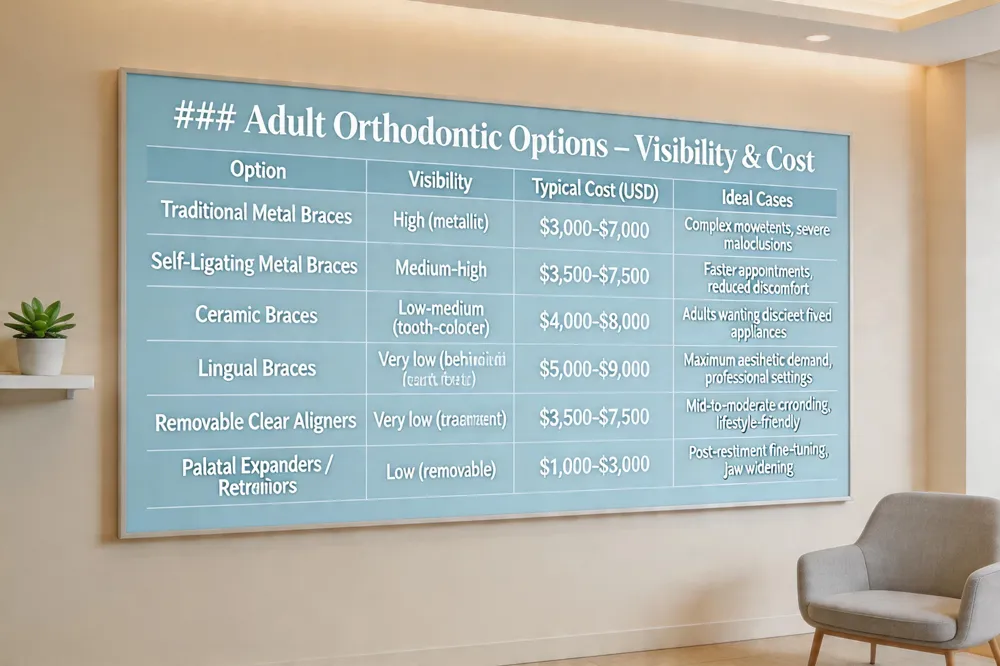 Adults have a wide range of orthodontic choices that blend effectiveness with subtlety. Traditional metal braces remain the most durable option for complex movements, while self‑ligating versions reduce elastic ties and often feel more comfortable. For those who prefer a low‑visibility look, tooth‑colored ceramic braces blend with natural enamel, offering a discreet appearance without sacrificing the force of a fixed appliance. Lingual braces, bonded to the back of the teeth, are virtually invisible from the front and are the most unnoticeable solution for adults who want a completely hidden system. Removable aligners such as Invisalign or ClearCorrect provide an almost invisible, tray‑based alternative that can be taken out for meals, brushing, and special events, making oral hygiene easier. In some cases, removable retainers or palatal expanders are used after active treatment to fine‑tune alignment or widen the upper jaw. Before‑and‑after photos of adult patients typically show steady straightening over 12‑24 months, culminating in a balanced bite, evenly spaced teeth, and a confident smile. The best option depends on the specific issue—crowding, gaps, bite problems, or jaw irregularities—and personal preferences for aesthetics and lifestyle.
Clinical Considerations: Eligibility, Comfort, and Compliance
Clinical Considerations – Key Factors
| Factor | Description | Impact on Treatment |
|---|---|---|
| Rule of 5 | Face divided into five vertical eye‑width sections for aesthetic balance | Guides treatment planning and final smile harmony |
| 30‑Minute Rule | Replace trays within 30 min after removal | Maintains constant force, reduces bacterial exposure |
| Age & Bone Density | Approved for all adult ages; denser bone may slow movement | Compliance (20‑22 h/day) remains primary success driver |
| Severity of Malocclusion | Mild‑to‑moderate vs. severe skeletal issues | Clear aligners best for mild‑moderate; severe cases may need braces |
| Compliance | Wear time 20‑22 h daily | Directly correlates with treatment speed and outcome |
| Gum Health | Healthy gingiva required before start | Prevents inflammation and ensures proper force transmission |
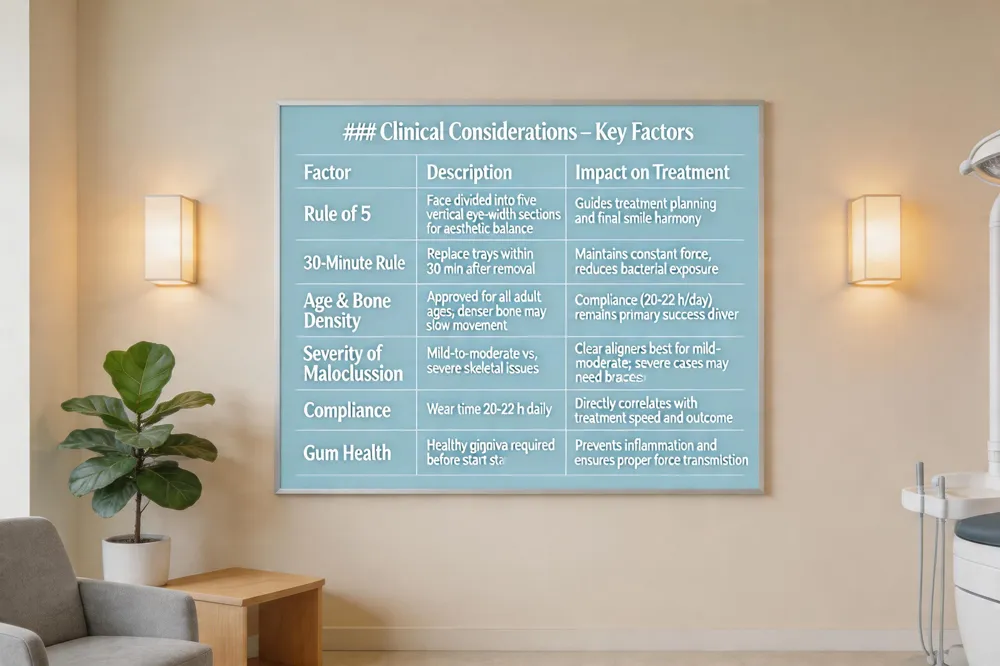 When an adult patient explores clear‑aligners, the orthodontist first checks facial harmony using the rule of 5. The face is divided into five vertical sections of roughly eye‑width each; equal thirds suggest balanced cheek, jaw, and ear proportions, guiding a treatment plan that supports both function and aesthetics.
The 30‑minute rule reminds patients to replace trays within half an hour after removal for meals or oral hygiene. This short window preserves the constant gentle force needed for tooth movement and limits bacterial exposure, helping keep treatment on schedule and teeth healthy.
Age limits and bone density: clear‑aligners are approved for all adult ages, even patients in their 60s, provided gums are healthy and bone support is adequate. As bone becomes denser with age, treatment may progress slightly slower, but compliance (20‑22 hours/day) remains the key driver of success.
Mild versus severe malocclusions: clear‑aligners excel at mild to moderate crowding, spacing, and simple bite issues. Severe skeletal discrepancies or complex movements often require traditional braces or a hybrid approach.
Frequently asked questions:
- Rule of 5 in orthodontics? It gauges transverse facial proportions by dividing the face into five equal vertical segments, each about the width of an eye, to ensure aesthetic balance.
- 30‑minute rule for Invisalign? After eating or cleaning, put the aligners back within 30 minutes to maintain pressure and protect enamel.
- Is 58 too old for Invisalign? No. Healthy adults of any age can be candidates; bone density is evaluated, not chronological age.
- Is 27 too old for Invisalign? Age is not a barrier; the system works for both younger and older adults.
- Adult orthodontia meaning? It refers to correcting tooth and jaw alignment in fully grown patients using discreet appliances like clear‑aligners, ceramic braces, or lingual braces, improving function, oral health, and confidence.
Financial Aspects: Costs, Insurance, and Market Trends
Financial Overview – Costs & Insurance
| Treatment Type | Cost Range (USD) | Typical Insurance Coverage | Financing Options |
|---|---|---|---|
| Metal Braces | $3,000‑$7,000 | 50‑80 % after deductible, lifetime max $1k‑$3k | Monthly plans, 0 % APR, HSA/FSA |
| Ceramic Braces | $4,000‑$8,000 | Same as metal | Same as metal |
| Lingual Braces | $5,000‑$9,000 | Same as metal | Same as metal |
| Invisalign | $3,500‑$7,500 | 50‑80 % after deductible, lifetime max $1k‑$3k | 0 % interest financing, monthly payments, HSA/FSA |
| ClearCorrect | $3,200‑$6,800 | Similar to Invisalign | Similar to Invisalign |
| Market Trend | 2024 valuation $3.5 B; 2033 projection $7.2 B (CAGR 9.5 %) | — | — |
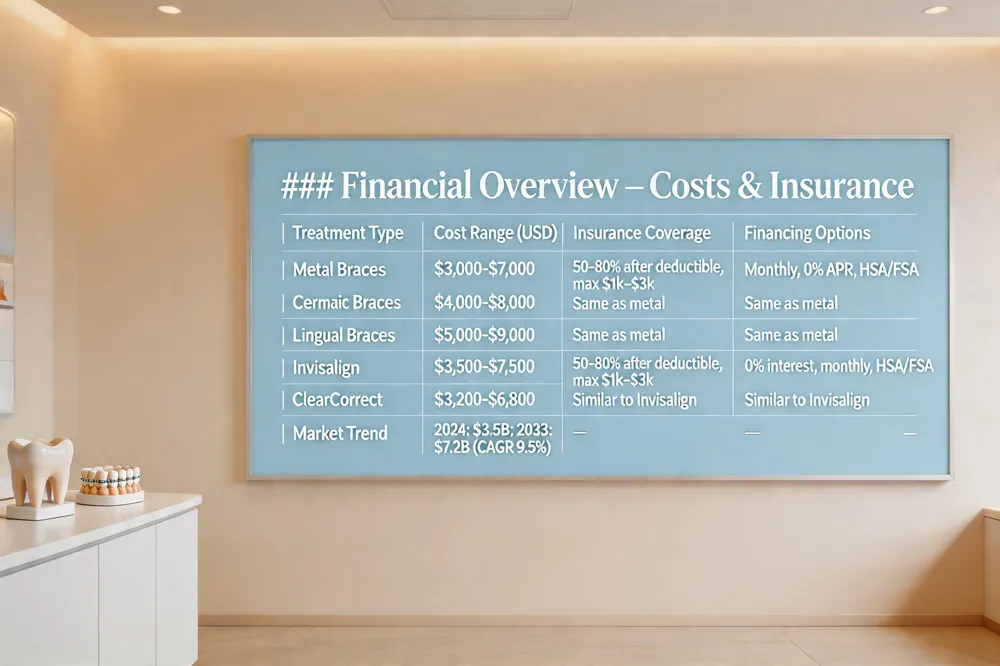 Adult orthodontic care comes with a range of price points. Traditional metal braces usually cost $3,000‑$7,000, ceramic braces $4,000‑$8,000, lingual braces $5,000‑$9,000, and clear‑aligner systems such as Invisalign $3,500‑$7,500. Insurance for adults is less common than for children; when it is offered, plans typically cover 50‑80 % of the eligible cost after a deductible, with a lifetime maximum of $1,000‑$3,000. Coverage is often limited to medically necessary cases (bite correction, gum disease) rather than purely cosmetic the.
The clear‑aligner material market reflects this demand: valued at $3.5 billion in 2024, it is projected to reach $7.2 billion by 2033 (CAGR 9.5 %). Advances in polymers and 3‑D printing keep materials strong, stain‑resistant, and increasingly recyclable.
Financing options make treatment more affordable. Many practices, including Loud Family Dental, offer monthly payment plans, 0 % interest financing, and accept tax‑free Health Savings (HSA) or Flexible Spending (FSA) accounts.
Adult orthodontic insurance – Most dental plans provide limited adult orthodontic benefits, usually a percentage of costs up to a lifetime cap.
Adult orthodontics cost – Expect $3,000‑$7,000 for clear aligners, with higher fees for more complex cases or premium materials.
Is $6,000 normal for Invisalign? – Yes; $6,000 falls within the typical $3,000‑$7,000 range for a comprehensive Invisalign treatment, depending on case complexity and provider fees.
Real‑World Examples and Patient Stories
Real‑World Patient Stories
| Person / Case | Treatment Type | Duration | Outcome |
|---|---|---|---|
| Kate Middleton | Invisalign | 6 months (pre‑wedding) | Discreet smile correction, high public visibility |
| Billie Eilish | Invisalign | 18 months (documented) | Successful aesthetic improvement, featured trays in music video |
| Busy Professional (Tech Exec) | Invisalign with remote monitoring | 12 months | Maintained work schedule, easy oral hygiene |
| Loud Family Dental Patient (Shreveport, LA) | Clear aligners with custom digital scan | 14 months | Affordable treatment via 0 % financing, high satisfaction |
| General Adult Cohort | Mixed (braces, aligners, lingual) | 12‑24 months | One‑in‑three orthodontic patients are adults; varied appliances meet diverse needs |
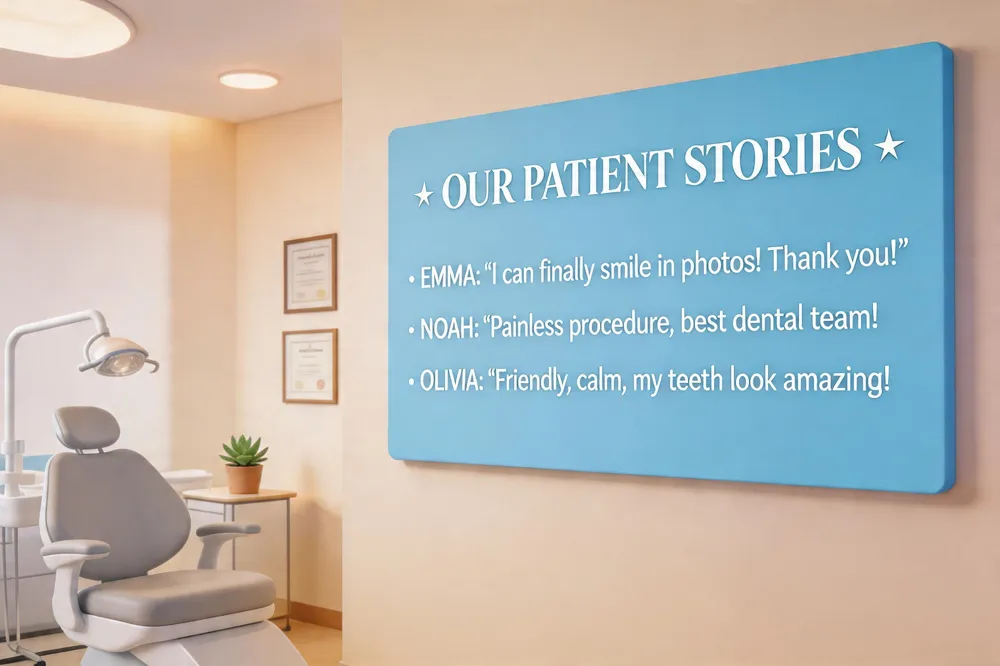 Clear aligners are not just a modern trend; they are a practical solution trusted by everyone from royalty to busy professionals.
Celebrity orthodontic journeys – Even high‑profile figures like Kate Middleton have turned to Invisalign for a discreet makeover; the Duchess completed a six‑month regimen just before her wedding, proving that a beautiful smile can be achieved without noticeable appliances. Pop star Billie Eilish documented her year‑and‑a‑half Invisalign journey, even featuring the trays in a music video to show fans that orthodontic care can fit any lifestyle.
Busy professional case studies – Adults in demanding careers appreciate the removable nature of aligners, which lets them eat, speak, and attend meetings without interruption. Remote monitoring apps and digital scans reduce office visits, making treatment fit seamlessly into packed schedules.
Loud Family Dental’s community‑focused approach – In Shreveport, Louisiana, Loud Family Dental combines state‑of‑the‑art digital scanning with personalized care, offering clear‑aligner consultations that emphasize comfort, safety, and affordability for patients of all ages.
Can adults get orthodontic treatment? Absolutely. One‑in‑three orthodontic patients today are adults. Modern options—including clear aligners, ceramic braces, and lingual systems—allow discreet correction of crowding, bite issues, and more, even though adult bone is denser and treatment may take slightly longer.
These stories illustrate that clear aligners deliver both aesthetic confidence and functional health for anyone ready to invest in a healthier smile.
The Future of Discreet Orthodontics for Busy Adults
Advances in artificial‑intelligence are reshaping how orthodontists design clear‑aligner therapy. AI‑driven treatment planning analyzes 3‑D scans in seconds, predicting optimal tooth trajectories and allowing clinicians to preview the final smile before any tray is made. At the same time, remote‑monitoring apps let patients upload photos or videos from home, reducing office visits and keeping busy professionals on track. Material science is also evolving; new sustainable polymers such as recyclable multilayer thermoplastics provide the same strength and translucency while lowering environmental impact. Finally, the clear‑aligner market continues to expand, with a projected CAGR of 9.5 % through 2033, driven by adult demand for discreet, comfortable, and convenient orthodontic solutions. Many insurers now reimburse part of the cost, and flexible FSA/HSA financing makes treatment affordable for busy adults.